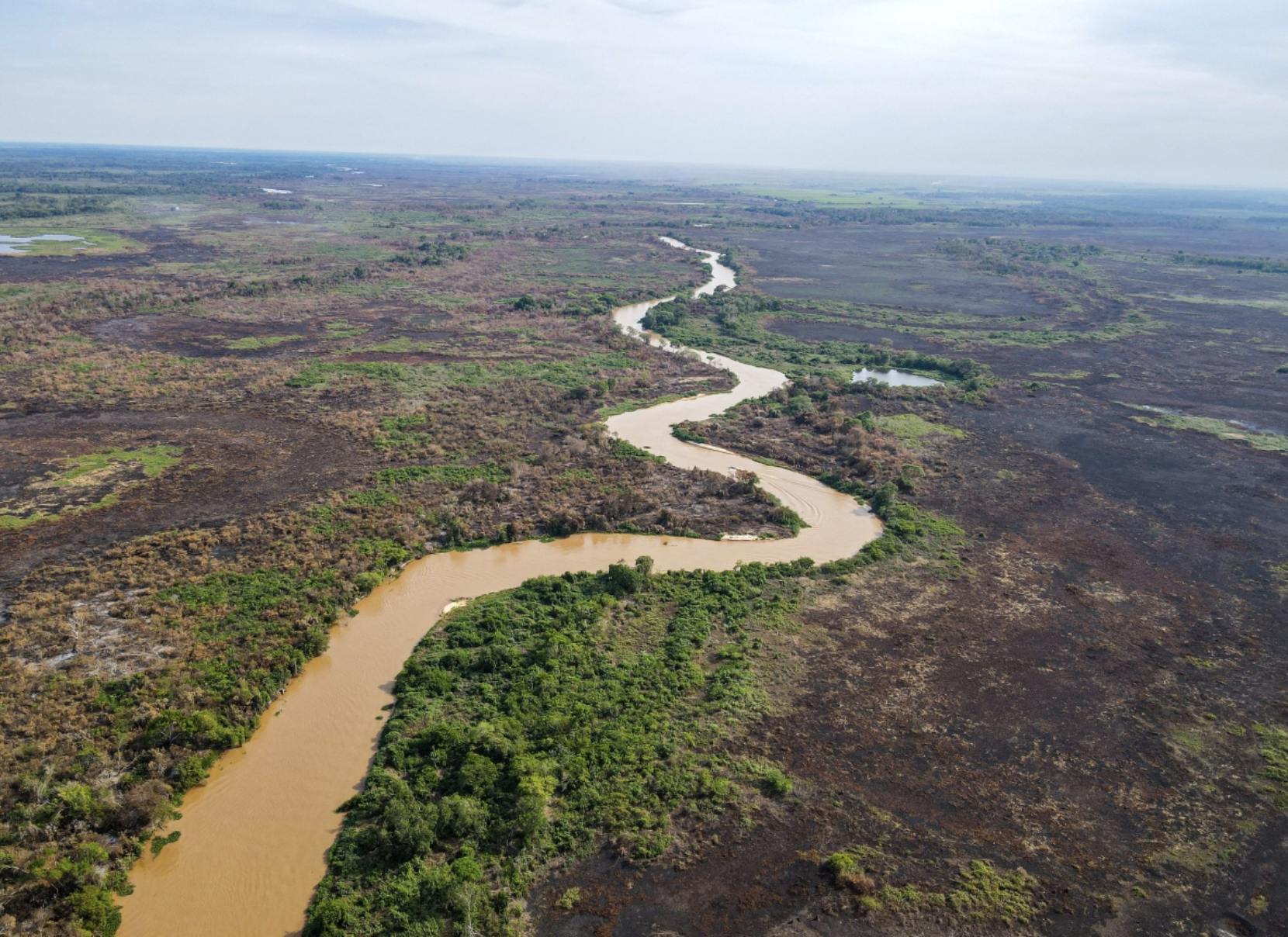
As Brazil prepares to host next year’s annual United Nations Climate Change Conference, COP30, the country’s government is attempting to send a message to the world about its commitment to environmental conservation and sustainable development, and in particular its efforts to protect the Amazon rainforest.
Yet, it is embarking on a controversial project that is at odds with these statements: the plan to rebuild the BR-319 highway through the Amazon. The proposal, which has sparked intense debate in Brazil and further afield, could disrupt one of Earth’s most important ecosystems.
The BR-319, an 885-kilometre highway, was inaugurated in 1976 by Brazil's military dictatorship to connect the cities of Manaus, the capital of Amazonas state, and Porto Velho, the capital of Rondônia state.
The road cut through one of the best-preserved areas of the rainforest, but its condition quickly deteriorated and it was abandoned in 1988. In 2015, Dilma Rousseff's government launched a maintenance program to revive some of the highway. Since then, various governments have made multiple attempts to reconstruct the remaining 406 kilometres, which snake through old-growth forest.
Most recently, president Luiz Inácio Lula da Silva pledged to begin reconstruction on the controversial section of the road before his term ends in 2026, claiming it is needed as the Madeira River, which is used to carry cargo between Manaus and Porto Velho, is drying up.
During a visit to Amazonas in September, Lula said: “BR-319 is a necessity for the state of Amazonas, it is a necessity for Roraima [another northern Brazilian state] and a necessity for Brazil.”
Lula and the Brazilian government may promote BR-319 as essential for regional economic development, but the project endangers at least half of the country’s remaining rainforest and puts 69 Indigenous communities, 64 Indigenous territories, and more than 18,000 Indigenous people at risk.
The president’s vow also appears to conflict with his ambition to lead on the climate agenda. Climate scientists have warned that re-paving the road could trigger a climate crisis chain reaction with severe irreversible impacts on the Amazon, Brazil and the entire planet.
Irreversible consequences
Speaking to independent media outlet AmazoniaReal last month, Rodrigo Agostinho, the president of Brazil’s environmental protection agency, Ibama, warned that the BR-319 project could become a “major deforestation front”.
This was echoed by Philip Fearnside, senior researcher at Brazil’s National Institute of Amazonian Research and a Nobel Peace Prize winner, who told me: “Repaving the BR-319 highway would link the relatively undisturbed central Amazon to the AMACRO region [named after the states of Amazonas, Acre and Rondônia].
“Although AMACRO is promoted as a sustainable development zone, it has become a major driver of deforestation in the Amazon rainforest.”
The highway could have other irreversible consequences, too, such as the loss of biodiversity and environmental degradation. The rainforest could be pushed beyond its ability to survive, causing it to cease functioning as a carbon sink and disrupting its role as a regional and global climate regulator.
On 29 October, the authorities organised a meeting at the Ministry of Environment to hear scientists’ evidence on BR-319. There, Lucas Ferrante, a researcher at the University of Sao Paulo and the Federal University of Amazonas, highlighted how repaving BR-319 will impact the so-called ‘flying rivers’ that he said play a “crucial role in regulating Brazil’s climate” – potentially leading to droughts.
“Moisture from the Atlantic Ocean is carried into the continent through the north region, where it enters the Amazon,” Ferrante explained. “Evapotranspiration from the preserved forest generates high-pressure systems that produce rainfall, which then travels southward, supplying water to the southeast, central-west and southern regions of Brazil.
“For instance, 70% of the rainfall that supplies the Cantareira system – responsible for providing water to São Paulo, the most densely populated area in South America – originates from this forested region. However, deforestation along BR-319 poses a serious threat to these flying rivers.
“We will face severe water shortages in densely populated regions, leading to the death of the most vulnerable populations, industrial disruptions, and devastating impacts on agriculture, rendering these areas uninhabitable. Essentially, the collapse of the flying rivers will trigger the breakdown of the country's economic sectors, potentially causing annual losses of up to $500bn.” Ferrante warned.
Repaving more of the road – and the increased farming that this will enable – will also worsen fires in the region, Ferrante explained.
He said: “Since 2023, Manaus has experienced a rise in smoke levels during the dry season, primarily due to forest fires spreading along the newly paved sections of BR-319, where cattle farming is rapidly expanding. The presence of asphalt accelerates deforestation, and fires are commonly used to clear land for pasture.”
From January to September this year, 22.38 million hectares of Brail burned – a 150% increase from last year, according to a survey by MapBiomas’ Fire Monitor, which tracks fire scars using satellite imagery. Over half of the burned area was in the Amazon.

Commenting on the fires at the 29 October meeting, Ferrante said: “It’s crucial to recognise that Brazil has surpassed its greenhouse gas emissions targets, with the highest levels originating from the Amazon due to widespread fires in the biome.”
Scientists have also warned that reconstructing the BR-319 highway would lead to increased human mobility and urbanisation of the Amazon rainforest, which is considered one of the largest reservoirs of zoonotic diseases in the world. They say this would heighten the risk of zoonotic spillovers – when infectious diseases jump from any animal species to humans – and could trigger further pandemics.
Deforestation along the BR-319 has already resulted in a 400% increase in malaria cases in the region, and an article published in Nature magazine in September reported that the western Brazilian Amazon is facing its largest confirmed outbreak of the Oropouche virus, which is spread to humans through the bite of infected midges and mosquitoes.
Some 6,300 cases of the virus – whose symptoms include nausea, vomiting and fever – were recorded between 2022 and 2024, with the majority of infections in 2022 and 2023 occurring in the heavily deforested AMACRO region. Researchers identified a novel genetic variant of the virus and highlighted fragmented forest landscapes and vegetation loss caused by deforestation and expanding agriculture as significant factors driving its transmission.
“Deforestation in the Amazon rainforest and other tropical regions,” added Fearnside, can “also contribute to climate change, which can create conditions favouring the emergence of parasitic, fungal, viral, and bacterial infections.”
Profit-driven
As Agostinho of the Ibama environmental agency pointed out to AmazoniaReal, neither the Ministry of Transport nor the construction firm it hires to rebuild the road will be accountable for managing the surrounding area. This remains a highly contentious issue.
The Brazilian government has continuously advocated for governance along the BR-319, but members of the federal police and army have made clear this is unrealistic. They say the inspection bodies lack the necessary resources due to the surrounding area’s vast size, complexity and danger.
A lack of governance would mean those financing illicit activities, such as illegal mining, logging, organised crime and encroachment on Indigenous lands, would be among the primary beneficiaries of the highway.
Land-grabbers have already built more than 6,000 kilometres of illegal roads on either side of the BR-319 – equivalent to more than six times the length of the highway itself. New official proposed roads along BR-319, such as the AM-366, would further provide loggers with access to a vast area of rainforest in the Trans-Purus region.
Legitimate industries – including agribusiness and cattle farming, large-scale biofuel production and the development of ‘bioeconomy’ – would also profit from the highway. These highly profitable ventures are financed by both national and international stakeholders.
The BR-319 will also play a crucial role in facilitating oil and gas exploration in the region. This includes the operations of Brazil’s state-owned oil company Petrobras along the equatorial margin, a project that has Lula’s full backing, and Russian state-controlled oil and gas company Rosneft. The latter holds drilling rights to 14 oil and gas blocks west of the highway, within the Solimões Sedimentary Basin, a pristine area larger than the state of California.
Ferrante elaborated on how BR-319 is facilitating the expansion of these industries: “BR-319 is accelerating the growth of agribusiness in the region, especially on unallocated public lands (‘terras devolutas’). Soybean farmers from Mato Grosso do Sul are migrating to Rondônia, purchasing land from livestock farmers who, in turn, are moving south of Amazonas within the BR-319 corridor.
“These lands are often occupied illegally, either through land grabbing, illegal deforestation, or violent eviction of traditional communities.”
Smokescreen
Supporters of the highway, including politicians and corporations, argue that the ongoing drought in the region is making transportation by the Madeira River increasingly complicated.
The river, a major tributary of the Amazon River that runs parallel to the BR-319 highway, has long been the primary transportation route in the region and offers a safer, cleaner and more cost-effective means of transporting goods.
But as Ferrante pointed out, the Madeira remains navigable despite the drought and the BR-319 doesn’t connect to any of the municipalities affected by the drought, as they are located across the Negro River.
Explaining the project’s local popularity, Fearnside said: “In Manaus, every politician supports the reconstruction of the BR-319 highway – on the condition that the federal government, and by extension, the 99% of [Brazilian] taxpayers who live outside Manaus, foot the bill.”
This “unanimous political support for the project”, Fearnside said, has “naturally prompted businesspeople to adopt the same position, given their reliance on political backing”. This is despite a 2009 environmental impact assessment finding that business leaders in the city didn’t consider the BR-319 a priority.
Fearnside added: “After more than two decades of consistent misinformation about the project, nearly the entire local population now favours it, and questioning the initiative would be political suicide for any candidate.
“However, academic studies assessing the project's feasibility have found it to be economically unjustifiable. Notably, it remains the only major project in Brazil without an official economic feasibility study (EVTEA), which is unlikely to be a coincidence.”
The government is required to carry out an EVTEA on all major infrastructure projects. The project has also breached Brazilian law and Convention 169 of the International Labour Organisation, a UN agency, by failing to consult with Indigenous communities.
Following his presentation at the Ministry of the Environment, Ferrante called for the suspension of all licences and tenders on the BR-319 until consultations with affected communities are held.
Citing the significant environmental harm that the National Department of Transport and Infrastructure has already inflicted on ecosystems, streams and traditional communities, he also urged the government to suspend the maintenance licence for the entire highway and remove the illegal roads along the BR-319.
*This is an edited version of a piece first published by The Canary