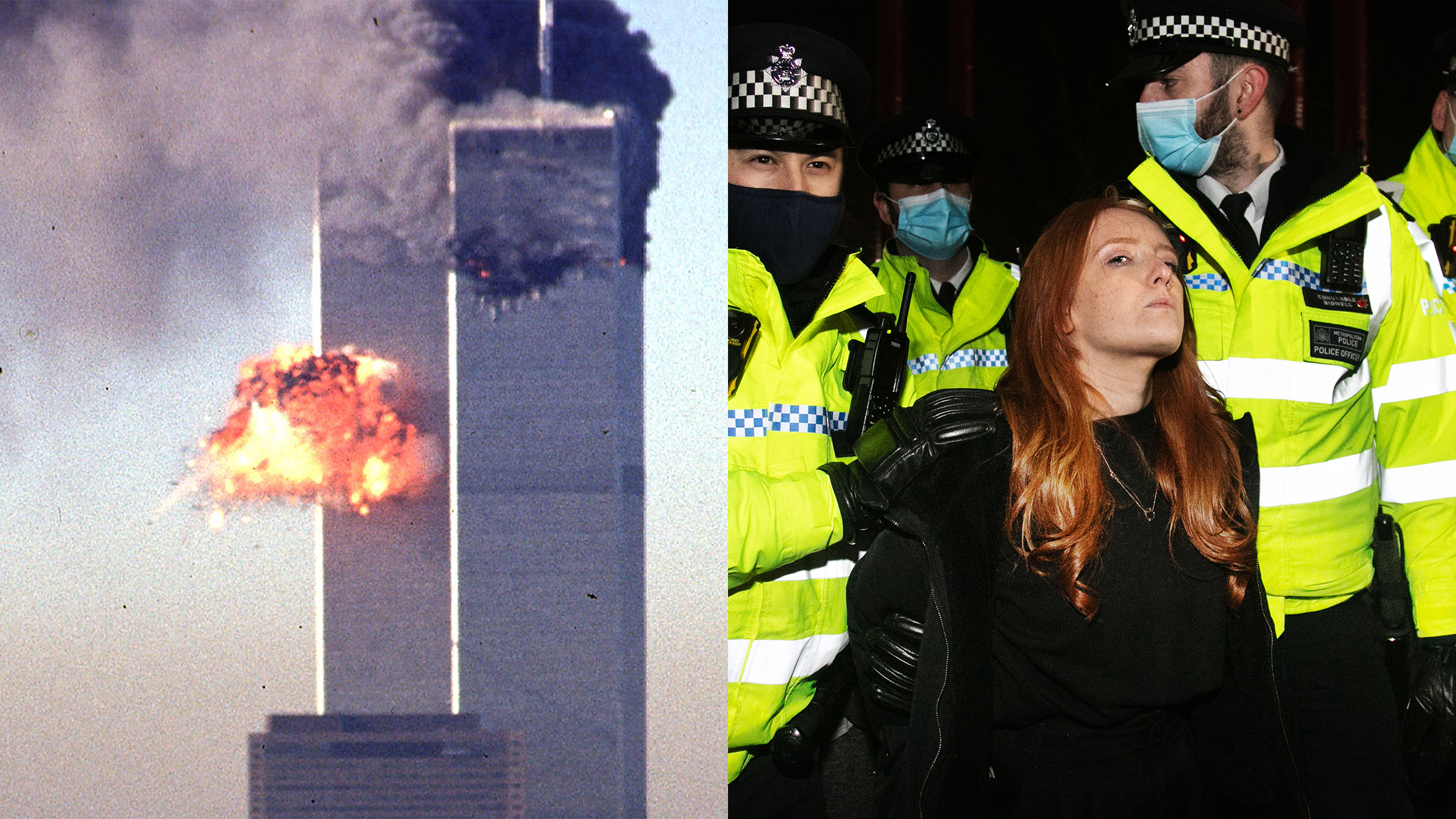
On 10 November 2010 a student-initiated protest erupted into British politics. It was followed by an extraordinary month of actions, campaigns, more demonstrations, civic swarming as well as marches, university and school occupations, friendly flashmobs that shut stores and generated media coverage of corporate and individual tax avoidance, and the storming of Parliament Square on 9 December, as the House of Commons voted to triple student fees. Thanks to online networks, over 30,000 turned out in a matter of days when the government decided to race through the legislation. Sixteen-year-olds from comprehensives and sixth form colleges in London’s East End joined Cambridge dons and inspired trade unionists as well as students from all over the UK. The police responded by trying to trap and then violently kettle as many protestors as they could. The corporate media sensationalised acts of vandalism but were unable to caricature the confrontation, thanks to the social media that dramatised what really happened. Public support was mixed and took on a life of its own as polls showed that opposition to the government increased.
Immediately the web filled with videos, photographs, testimony, blogs, arguments, twitter exchanges, facebook clusters, posters and graphic work. The experience of what happened is recorded in many outlets, told by those to whom it happened and who, more importantly, made it happen – the activists are also publishers and co-creators with their own voices. In this reader you will find just a modest selection but you can follow the links for much more. What strikes me is the range, good humour and truthfulness of the young protestors compared to the confinement and evasions of official politics.
Will these few weeks come to be seen as the start of a movement that reshapes the wider politics and culture in our country and shifts the balance of force between authority and people?
If so the birth was sudden, forceful, and for some of us bloody. It was also surreal. Prince Charles, heir to the throne, had recently declared "I can only, somehow, imagine that I find myself being born into this position for a purpose." The purpose, he concludes, is to lead us to environmental “Harmony”, the title of his latest book published in time for Christmas. It opens with the declaration “This is a call to revolution”. On 9 December he ordered his chauffeur to drive his Rolls Royce amidst his fellow revolutionaries. Perhaps he felt that he and his wife would be greeted as comrades. Instead, they met with the great republican slogan of high Victorian confidence, albeit originally uttered by Lewis Carroll’s Red Queen, “Off with their heads!”
A new movement? Round up the usual gatekeepers! Quite an alliance of forces are darkly jealous of its potential energy and fresh celebrity – stretching from News International through the Tory, Labour and Liberal Democrat parties and goodness knows how many NGOs and bloggers. The gatekeepers even include those on the far-left who helped it burst into existence but want to oversee it for themselves. But this baby, as the readers of this collection can see, is not so inarticulate or shapeless. Instead, there is a conscious sense of originality thanks to the power of the modern forces that have propelled its birth. These give credibility to its double wager of defiance: that what the state, the government, and the corporate media offer to the country and especially its young as our fate is unacceptable, and that the claim which accompanies it, that there is no viable alternative, is a lie.
Is it possible to have a new movement baptised by an act of lèse-majesté? Like many a new life it is needy and inexperienced. It enjoys an inspiring, protoplasmic will, and a capacity to make noise out of proportion to its size. And it is vulnerable. It lacks coherence. It could be snuffed out, or broken by internal differences. But it exists in a country that since the scandal over parliamentary expenses in 2009 has clearly needed a new, strong voice of opposition to the way we are governed outside official channels.
Now we have one. In a welcoming spirit of solidarity and kinship, therefore, openDemocracy’s UK section, OurKingdom, is publishing Fight Back! A Reader on the Winter of Protests – and is learning and being changed in the process. These days everyone wants immediacy and the first question being asked is whether the movement will grow. But there are different kinds of growth and I think the most important question is whether something new has started that will last.
I hope you will read this book with an open mind as the answer is going to be multi-layered. It depends on the forms of organisation adopted by the protestors, how links are made with others, on the music and culture that is being created, and most important on the nature of our epoch and how open it is to change. The voices of the winter protest can be judged in terms of naivety or maturity – but what really matters is the opportunity. Of course there is evidence of idiocy, over-optimism and simplification as well as the usual drawbacks of student politics. But the wider anti-cuts protests that began in late 2010 are not just about fees, and reached well beyond students – thousands across the country who are not in higher education are helping to create it. Exceptional economic, social and technological transformations are underway. Will the budding movement have the energy, audacity, persistence, imagination and intelligence to make the best of these changes?
Losing the future
In the 1980s the socialist cultural critic and novelist Raymond Williams observed that the left in all its varieties had lost hope in the future. As Britain’s attempt at social democracy decomposed and the Soviet bloc stagnated, the left became sclerotic with nostalgia. At the same time, Conservatives ceased to be backward-looking and embraced growth and market optimism. New Labour’s canny response under Blair, Brown and Mandelson was to embrace capitalist globalisation as the replacement of internationalism. Instead of reinforcing the sense of closure that Williams diagnosed, this created a countervailing confidence in ‘progress’ thanks to the expansion of the bubble economy and the funds it generated for public investment under New Labour. But its embrace of market fundamentalism proved its undoing. The bubble of the North Atlantic economies burst in 2008 and in the UK this was closely followed by a political crisis, as the MPs expenses scandal, itself part of the wider stench of entitlement and greed, shattered popular belief in the historic integrity of parliamentarians as a whole.
The electorate judged that no one party was up to the job of repairing the damage. It voted to hang parliament in the May 2010 general election. But the Tories proposed a wholehearted partnership to the Liberal Democrats as a way out. The resulting Coalition government offered voters an apparently honest response to the twin financial and political emergencies, through a combination of principled compromises on policies and a belt-tightening exercise to secure the economy. It also committed itself to free the people from New Labour’s overbearing state and its interfering assault on liberty. In this way, presented as a relatively youthful but not undignified politics of restoration, the Coalition was widely welcomed. It turned instead into a two-faced, unprincipled exercise: while reassuringly Whiggish in appearance, it drove forward market fundamentalism within the public sector faster and more ruthlessly than even Blair and certainly Thatcher would have dared to contemplate, with disregard for traditions and institutions. At its core is a deficit-reduction strategy that places support for the bond market, and preserving the City of London as a base for financial globalisation, above everything.
This policy is being most dramatically implemented in higher education. How it came about is essential background to the protests as it shows how the issues of fees and how to pay for universities combined from the start with a much wider philosophy of marketisation that is now attempting to redefine the very purpose of education itself.
The Browne Review
In the beginning was the master manipulator: the yachting companion of George Osborne, New Labour’s Peter Mandelson. Brought back by Gordon Brown to save his premiership, Mandelson became Secretary of State for Business, Enterprise and Regulatory Reform in 2008. He then body-snatched the Department for Innovation, Universities and Skills to become overlord of the Department of State for Business, Innovation and Skills. Thus our universities and hundreds of thousands of students found themselves under the control of a department that had neither ‘education’ nor ‘universities’ in its self-description. And this is where they now belong.
Within five months Mandelson published Higher Ambitions: the future of universities in a knowledge economy. It praises the expansion of higher education under Labour and the tremendous investment in British science and advanced research. It sets out a case for more than half of all young people having further education, to widen access and raise standards. There is a touch of pluralism about it too, “Universities have a vital role in our collective life, both shaping our communities and how we engage with the rest of Europe and the wider world”. But overwhelmingly it presents a business case for education as a means to an end, for the individual and society:
“Higher education equips people with the skills that globalisation and a knowledge economy demand, and thereby gives access to many of this country’s best jobs. Everyone, irrespective of background, has a right to a fair chance to gain those advantages.”
To achieve this Mandelson opens the way for increasing fees. Again, in his own words, “It is necessary to look afresh at the contributions of those who benefit from higher education… the Government will commission an independent review into this question.” This became the Browne Review.
In a far-sighted assessment of Mandelson’s Higher Ambitions when it was published in November 2009, Alan Finlayson warned that even in business terms what was needed was the opposite of what it proposes. Britain should move to a broad, US style, liberal arts education, says Finlayson, giving an understanding of scientific methods as well as core principles of history and philosophy, “to impart skills that a wide range of employers welcome, and to create citizens conscious of their place in history and confident about acting in public life”.
Alas, Mandelson appoints John Browne, the disgraced ex-head of BP, to carry forward his work. The original brief was technical. But if your starting point is that money is all that counts, you naturally proceed to pass judgment on everything in these terms. At BP, Browne had demonstrated a quite exceptional talent to impose his narrow-minded vision. As Tom Bower aptly put it, he changed the company’s culture from oil engineering to financial engineering (opening the way to the recent disaster in the Gulf). Browne approached universities with the same simple zeal. He saw them as cost-centres of educational engineering and proposed turning them into places of – what else? – financial engineering. Which in this case means making them campuses that focus on the enhancement of earning power.
His review is published on 12 October 2010, and the government accepts his proposals except that it caps fees at £9,000 rather than allowing them to be unlimited. Far from opposing New Labour’s inheritance, which it scorned in public, the Coalition embraces it with vengeance. In the course of a few days, with the country hardly aware of what is happening, it is agreed that the totality of the government’s direct public provision for teaching the humanities (and 80 per cent of all university teaching revenues) disappears next year. Funding will henceforth be routed through students in the form of loans. But what is being presented as a technical answer to a question of payment is in fact a life-sentence passed on the future generations of students.
I know of no one who thinks that universities don’t need to be significantly improved or that there are not genuine questions concerning the future of higher education, such as raising quality, how to create a system where everyone can credibly aspire to the jobs they want, the implications of meritocracy, combining vocational and academic skills, education being for living as well as employment, and how the web might open up access.
Browne ignores all this. Higher education is defined as an investment made by students to enhance their employment prospects in a corporate world (while corporations start to take over and run universities for a profit).
The student’s choice is dressed up as freedom backed by government-secured loans. But they are obliged to pay to enter what many understandably feel to be a choiceless world.
I am not exaggerating. Browne states that there is simply no “objective metric of quality” available with respect to higher education to decide how to “distribute funding”. Therefore its money should follow student choice (p25). In order for students to choose there will be “certified professionals” appointed to every school, using a “single online portal” for applications and information (p28). This portal will:
“…allow students to compare courses on the proportion of students in employment after one year of completing the course; and average salary after one year. Employment outcomes will also make a difference to the charges set by institutions… its charges will become an indicator of its ability to deliver – students will only pay higher charges if there is a proven path to higher earnings… Courses that deliver improved employability will prosper; those that make false promises will disappear.” (p28)
The whole of education is perceived as a means to an end. The possibility that education might be an end in itself, that it can be dangerous and liberating, that it might open up choices and enhance one’s self-development, that it can be life-changing and that society as well as individuals might wish this to be so, is just about allowed for in the Mandelson report because it includes vivid testimony from specific universities. In Browne, the absence of such possibility is suffocating and complete.
The Coalition’s collision course
By embracing Browne the government backs his drastically one-dimensional approach. Our response should not be to deny that instrumental calculations (including the liability of taking on debt) are part of life, they are; or that students should not be able to demand a proper education; they should. What needs to be said loud and clearly is that the idea that loans to students should be the only way in which we as a society fund humanities education; that to survive and prosper universities must think exclusively in market terms about what jobs they deliver; that our society with all our history and experience is incapable of agreeing on a mixture of other ways to recognise “quality” in higher education, is altogether abhorrent.
That a horrific approach to higher education is decided and becomes law in a few weeks with no proper debate or consideration of alternatives suggests a society whose political system is close to breakdown.
It is not surprising that ambitious and creative young men and women respond by saying, ‘hold on a moment’.
The Coalition’s justification is that swift measures are essential to cut expenditure and eliminate the deficit over the course of a single parliament. But Cameron’s underlying desire to privatise the public realm, or as he puts it, oversee a change from “state power to people power” (of which his ‘Big Society’ is a part), is not a deficit reduction strategy at all. It dates back, he told the Conservative Party conference on 6 October 2010 – indeed it is a point he insists on – to well before the financial crash. He was speaking as the Browne Report was being prepared for publication. He proclaimed that his government had begun a “revolution” (its seems quite a popular word these days amongst the old ruling class) and he boasted, “We are the radicals now breaking apart the old system”.
It was true, but only for 34 days.
Then his party headquarters at Millbank by the Thames was stormed.
The pivotal moment of Millbank was not the smashing of the glass into the entrance, the trashing of the lobby by the young mob and the triumphant race to the roof by a relatively small number of exuberant protestors. It was the larger crowd outside. It was the thousands who cheered them on. They knew that this would break through the indifference of the media, that they were making their case in the only way the spectacle respected, that their anger would be on TV and in the press. They were cheering something much greater than a protest over fees.
When they say, "cut back!"
We say, "fight back!"
This was the chant that defined the cause. It is a response to the entire approach of the Tory-Liberal Democrat Coalition, and not just fees.
The National Union of Students organised the 10 November demonstration. Later, an informal network called for another manifestation and after taking to the streets of London, university occupations began. Enter UKUncut and False Economy: in parallel with the student protests, they provided a platform to organise wider protests against the cuts.
UKUncut initiated enjoyable, peaceful but unruly flashmobs. On two Saturdays I joined them in Oxford Street as we temporarily closed high-street chains like Top Shop, Vodafone and British Home Stores, explaining to shoppers how these chains were implicated in tax avoidance, with similar actions taking place in high streets across the UK.
The web generates a wide number of weak connections. In contrast, direct actions and especially occupations can create intense friendships as people collaborate in open struggle. An experience of agency, of self-determination, of being an influence, with all the passionate negotiations and searching for consensus that is bound up with making change, started to transform demonstrators into activists.
The National Campaign Against Cuts and the London Student Assembly, working with the occupations, organised the 9 December march on parliament: over 30,000 sweep unstoppably on Parliament Square as the most far-reaching single reform of English higher education is being raced through the House of Commons, in the form of secondary legislation, incapable of amendment, in a single three-hour debate. For the first time in a century, since the suffragettes, a police cordon gets thrown directly around the Palace of Westminster to protect MPs as they prepare to vote. Helmeted police with riot shields stretch from opposite Big Ben to right past the House of Lords as a free festival of protest takes place in the square itself. By 3.30 in the afternoon the police vans and horses start to move in, in full riot gear. Having failed to stop parliament from being surrounded, they were not going to let it end peacefully, as you can read in several eyewitness accounts that follow.
From protest to politics
Student militancy draws on a variety of sources and experience over the past two decades. Among them are Reclaim the Streets, Climate Camp, militant environmentalists, and the demonstrations that marked the meeting of the G20 in London. These developed techniques of networking, consensual organisation and activist solidarity. Awareness of the nature of the surveillance society and its policing techniques was dramatised by the Convention on Modern Liberty in 2009 (supported by 50 organisations, among them The Guardian, openDemocracy and the activist network NO2ID; Henry Porter and myself were co-directors). The far-left maintained a steady organising presence. A lively left blogosphere, full of ideas and with a focus on action and solidarity, began under New Labour and was stirred up by the general election in May, encouraged by group blogs like Liberal Conspiracy and The Third Estate.
Then there are the Liberal Democrats. They had recruited among students as part of the growing opposition to the two main parties. They preached that politicians had lost the trust of young people but that they were the solution as they alone could actually win seats and stay honest and be trusted. With the student vote increasingly important in university towns where the Lib Dems did well, they had gone out of their way to pledge in writing that they would not support any increase in fees. They did not just ‘break’ this promise. It was a betrayal – creating intense anger because they had recruited on the even more important promise that they were different and would do no such thing.
From dramatic high-risk forms of resistance to tactical voting for Clegg and his party, all these actions, conferences and reactions, were protests. By contrast, the experience recorded in these pages suggests that the “fight back” of winter 2010 contains the seeds of a politics.
Here is why:
- The protest movement born in the winter of 2010 is directed at the totality of the government’s economic policy and therefore engages with the state’s management of democracy and power. At the same time the government’s attempt to save market fundamentalism means preserving an unparalleled degree of inequality in terms of top salaries and bonuses. This super-inequality has lost all public credibility since the crash. Market fundamentalism is losing political legitimacy, a profound shift that opens up a space for far-reaching challenges to thrive.
- One of the drivers of the crisis has been capitalism’s capacity for productive transformation as well as financial bubbles, in this case the upturning of productivity thanks to the microchip and the internet. Student occupiers had more computing power in their laps than NASA when it sent Armstrong to the moon. Social networking is already transforming the way social decisions are being taken, which is itself a definition of politics.
- A politics without a culture is merely technocratic. But we are at the forefront of an immense cultural transformation – not necessarily positive, but that’s the point, a complex confrontation is underway. This applies especially to what it means to be educated and therefore cultured. It goes much further than working class access and costs. The principles of the Enlightenment, from human rights to the influence of religious belief, are in play.
- The Westminster system has entered an endgame. Higher education has been swept into the department of business; the Browne proposals have become law; all this and much more has been driven through without a proper debate in the Commons, let alone pre-legislative scrutiny and the chance to propose alternatives. There is little meaningful democracy, the ‘sovereignty of parliament’ is a joke, reliable checks and balances have ceased to exist in the UK: the executive rules and the constitution is broken. Hence the need to riot.
A political process that is losing consent; an economic order whose inequalities have undermined its legitimacy; the arrival of new ways of organising power and influence thanks to technology and social media; taken together such a combination makes it possible for an influential democratic movement to emerge – one which does have a belief in the future.
The new Levellers
Nationally, however, the right is still in the ascendency and internationally it is ascendant. It too is using new technology for its ends and is debating how democracy and the economy should be organised in its interests, in an era when the traditional political party is in advanced decomposition. That the internet will indeed change things deeply is for certain, how it will do so is not pre-determined.
So this is quite a dangerous moment for the movement if it is to grow, and evolve, and become more than a protest.
The first demonstration of 2011: a symbol of parliament itself, a 20 foot high effigy of Big Ben, is burnt on 2 January. It takes place far from crowded streets in a clearing within the historic Royal Forest of Dean. Local people are determined to protect their forest from being sold off into commercial hands. This poses an issue that haunts British politics – the UK’s national question. Should the Coalition insist on its plan to sell off our woodlands, can the cities link arms with the countryside to overcome one of the most crippling divisions in English democracy?
The Coalition’s decision to abolish the EMA, the Educational Maintenance Allowance for 16-19 year olds from poorer and very poor households, created furious opposition in schools and sixth-form colleges with a high proportion of working class children. Many joined the demonstrations which, from the start, were not confined to ‘privileged’ students of whom there are anyway over a million. Cross-class solidarity was built into the DNA of the movement against the cuts from the start, while trade unions leaders, as these pages record, welcome it.
On 8 January the TUC helped host a meeting of NetrootsUK at Congress House. Perhaps only 10 percent of the 500 online activists who attend are trade union organisers, but in terms of the British labour movement it is an exceptional exercise in openness and shows a remarkable lack of tribalism. The TUC has called for a massive demonstration on 26 March. This is likely to be supported by local councils who hate being forced to implement cuts, as well as many from across the NHS now undergoing its own radical marketisation. It is very early days, but the students may be initiating a social movement that addresses the larger interest of society.
Members of political parties are sniffy, while Labour ones claim that it is they who should speak for any new opposition. Certainly, they badly need more energy. But one of the inspiring aspects of the protest movement is its sensitivity to process. It is not whether Labour or the Greens of the Scottish or Welsh nationalists support this or that policy on education or the cuts that will count, but how they do so. Can Labour open up to the widening force of the anti-cuts movement so that it is changed by it? It may then have a chance not just of being re-elected but also of governing better when in office.
The Coalition’s “revolution” will make Britain a safe haven for international finance and corporations in the hope that they will ensure domestic economic growth from above. But what kind of economic development and self-government will the opposition to this fate propose in its place? The Coalition is busy modernising parliament: equalising constituency sizes, reducing the number of MPs, replacing the House of Lords, while reinforcing the exceptional power of the executive over the Union. What counter-programme of democratic reform and what kind of state is needed to enhance our democracy now that a return to the status quo seems impossible?
Amongst the students the debate is more radical despite the danger of looking inwards. Two broad approaches are engaged in what can very roughly be described as an argument between two traditions, that of Lenin and that of the Levellers. Leninism distrusts participation and engagement, fearing it will become contamination (unless it is disciplined by ‘entrism,’ or other forms of undercover activity). It seeks polarisation while it waits for the larger crisis and total insurrection. My own preference is for the Leveller tradition, which is altogether more open. Many of the current movement’s egalitarian hopes are familiar and none the worse for that. They go back to our Civil War when the first modern call for political equality went out, “The poorest He that is in England hath a life to live as the greatest He”. It is a tradition that threads through the works of William Blake, Tom Paine and Shelley and the spirit of the suffragettes and it has awoken from hibernation. It is inventive, humane as well as radical, engages with the economic and political forces around it and calls for liberty and rights.
New technology has the potential to empower this ‘Leveller tradition’ of radical self-determination. One of the themes running through these pages is a feeling that the profound socio-economic changes and the collapsing costs of communication have made it possible to achieve a modern livelihood through mutual ownership, economic optimisation rather than maximisation and co-creation (and creative commons copyright under which this collection is published). Ironically, those who want to limit the marketisation of everything are starting to enjoy the technological capacity to do this, thanks to the immensely productive expansion of capitalism.
Perhaps another way of registering how genuinely radical the historic moment is, is by asking who are the conservatives and who are the extremists?
Are the conservatives really the Etonians who want us to buckle down to globalisation as they sell off the forests, tender NHS provision to US for-profit health providers, marketise education and give parliament a good slapping? Are these the traditionalists?
Are the extremists really those who want to preserve the status of the forests, ensure that those who run the NHS believe in it as a public service, see education as about developing our human capacities, practical as well as intellectual, and call for pluralism and mutual respect? Are these the revolutionaries?
We were supposed to sit back and admire the Prime Minister and his deputy, as they displayed their radicalism on our behalf. The police were doubtless prepared for small numbers of objectors. Now, both in fact and metaphorically, an effort is underway to corral the unexpectedly numerous expressions of resistance and throttle them. Our ‘leaders’ would prefer to close down the attitudes, ideas and militancy of the winter protests evident in Fight Back! They want to ensure that the energy, intelligence and inventiveness are contained, that its thinkers, artists, bloggers and activists squabble, divide, are rendered harmless and do not develop a politics which lasts or ideas that are of any influence. The book’s editorial flashmob have all literally been kettled by the police. I feel that they are not going to be successfully confined. But a much larger exercise is underway to kettle the spirit and creativity of the potential movement against the cuts and market fundamentalism, so as to isolate it from society. We must do everything we can to make sure that it remains open and free to grow.
Read Fight Back! or download a pdf here.