
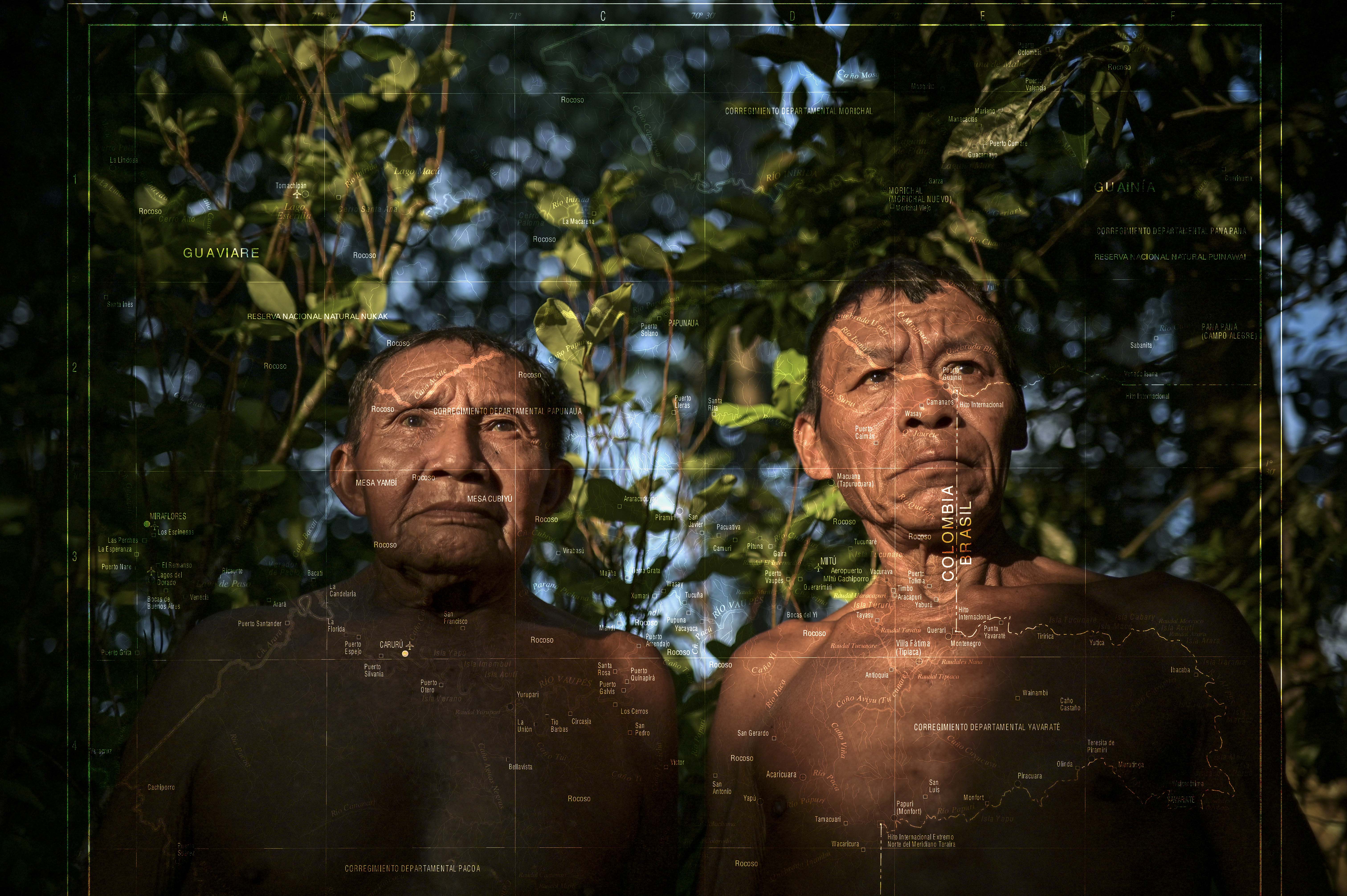
Through prayers, dances and songs, the indigenous people are fighting against mining. A coltan mining contract threatens the knowledge of ethnic Amazonian groups.
In Timbó de Betania, grandfather Reimundo Montalvo, is one of the sapient men who takes care of the hills through prayers. He is 74 years old and belongs to the Desano ethnic group. He is located in the maloca, which has a wide roof that has fallen to the ground and is built from wood and dry palm leaves. He is thin and black-eyed and his wrinkled face maps out his long life.
The elder smokes tobacco while praying for those who come to visit the community, to heal pains and illnesses, and to keep away those who want to take their wealth.
"I make sure they don't enter the territory," he says, referring to the miners. He only speaks the native language, which is somewhat foreign, so Wilmer Andrés Ardila Montalvo, one of his relatives, helps with the translation. Both explain that gold and minerals are elements they use for healing and that there is even a prayer alluding to the precious yellow metal.
He also prays for the indigenous people to go to work, at the beginning and end of each harvest, when there is birth and death, and to seek harmony from the beings of nature.
His biggest desire is that his ancestral practices are learned by the young people. He is aware that knowledge is being lost every day, particularly the knowledge that protects the sacred sites such as the hills, the salt flats and the rivers.
“My fear is that the next generation will have to suffer the consequences of this. So that we don’t lose the ancestral knowledge, I am inviting young people to join me, and listen to the prayers," he says, as he acknowledges the possible impacts of mining. For Reimundo, passing on beliefs is another way of defending the territory.
The same defence is used by the indigenous children of the neighbouring community of Bogotá Cachivera, 20 minutes from Timbó de Betania. In the maloca, they perform a traditional dance, while their teacher, Leonardo Francisco Villa Morales, plays two native instruments, the shell of a turtle and the carrizo (a kind of flute).
The children, between the ages of eight and thirteen, wear feather crowns on their heads, maracas made of Calabash tree in their hands and seeds on their ankles that sound when they stomp the ground. They dance in gratitude to the earth and their ancestors.


Leonardo, 46, of the Siriano ethnic group, is the only cultural savant left in his community. He says that every Wednesday he teaches, the 27 students at the Bogotá Cachivera school, dances, songs and instruments he learned from his grandfather, which have also been threatened. For Leonardo, the influx of Western culture, religions and the various forms of exploitation that the Amazon has had (such as rubber, leather and wood), have taken away their ancestral knowledge and now they fear mining.

In Bogotá Cachivera, where 22 families belonging to the Sirianos and Desanos ethnic groups live, mineral exploitation is not unknown to them. According to the stories of the local elders, eleven years ago on Bastón Hill, located less than two kilometers from the village, some indigenous Brazilians extracted gold in drums. Now, they are worried about being affected by the license granted between Timbó de Betania and Murutinga.


They were not consulted for the extraction of the black lands. As in the aforementioned settlements, they knew about the contract and are concerned about its consequences. In the school and in the hut, there are posters with photographs of El Cerrejón coal mine in La Guajira, showing the damage caused to the Wayuu indigenous people. The social, health and cultural impacts of medium- and large-scale mineral exploitation have been reported, so they reject any type of mining. They have also learned about prior consultation and their collective rights, which have been provided by the Mitú community centre.
"I hope that this mining license does not exploit our province, they have not been given our permission to do that,” says Víctor Villa Morales, who for more than four years has been a captain in Bogotá Cachivera, a community that bears the name of the capital of Colombia because the wind there is cold.

“As long as they (the miners) are not here, we are still fine, we dance and live well, we play all the instruments, and when the miners arrive to exploit our resources, it will be over because we are already like slaves, we have to go to work there, so the cultural teaching that we had, will be left on the other side", that is Leonardo's fear, who plays and shows a totumo maraca painted with figures that represent the birth of the sun, a hill and a seated maloca.
In this area of Vaupés, one of the farthest reaches of southeastern Colombia, indigenous life is strong, sapient and, above all, their communities endure with their culture, traditions and their voices in defence of the hills, the territory and life
****
Agenda Propia, with the support of the Pulitzer Center and the Rainforest Journalism Fund, went into the forests of Vaupés to walk through one of the territories of the Amazon that is in the sights of foreign companies for the exploitation of coltan, a combination of the metals columbite and tantalite, also known as black lands. This is the third of 4 parts. Read the first part here and the second part here. Originally published in Agenda Propia
Editorial coordination, journalistic research and texts - Edilma Prada Céspedes
Photos and Video- Luis Ángel
Text edition- Nathalia Salamanca Sarmiento
Web design and graphics -Mariana Villamizar and Camila Achuri
Social Media Creative Design- Paola Andrea Nirta Pérez
Media allies - Open Democracy, InfoAmazonia, Public Issue, Public Eye, Datasketch, Connectas, El Espectador
This project was funded by the Pulitzer Center and the Rainforest Journalism Fund.


