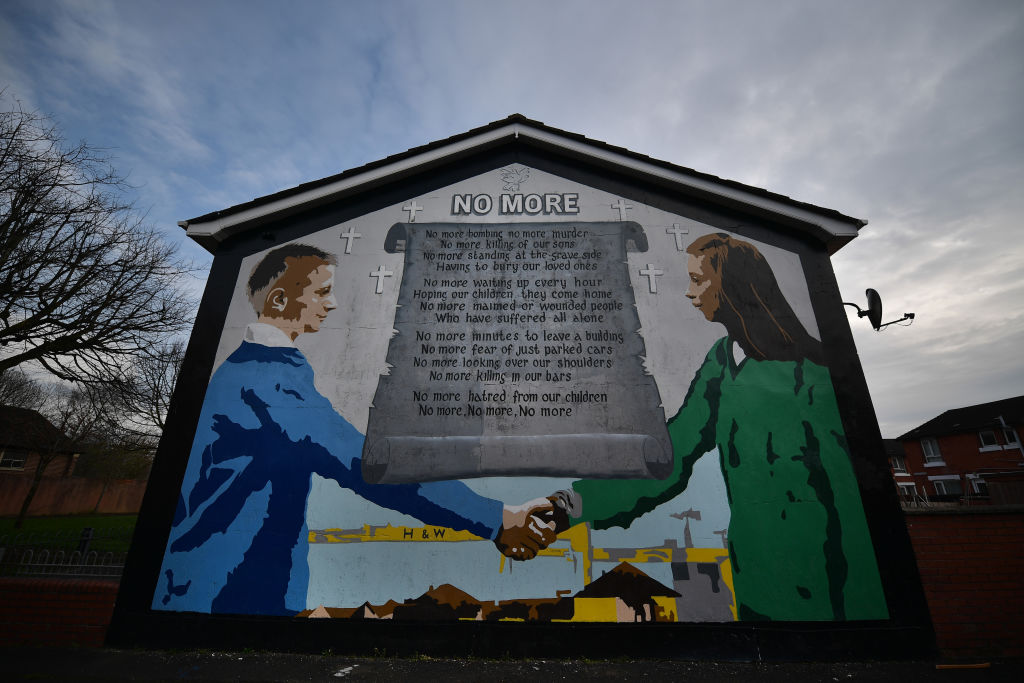
If the first day of an event to mark the 25th anniversary of the Good Friday Agreement was anything to go by, Northern Ireland’s Democratic Unionist Party is in for a difficult week.
As global leaders and key negotiators of the peace deal descended upon Belfast, the party came under the magnifying glass and found little favour in a room of people who took significant risks to build peace in the North in 1998. A quarter of a century on, and 15 months into the DUP’s boycott of Northern Ireland’s power-sharing institutions, the party is running out of road – and out of friends.
Former US secretary of state Hillary Clinton, the chancellor of Queen’s University Belfast, where the conference is being held, said “governing together took courage”, while former British negotiator Jonathan Powell bluntly stated that the DUP need to get back to Stormont, “otherwise we are in a complete cul-de-sac”.
And a keynote speech from former US senator George Mitchell, who drew from his experience serving as US special envoy, during which he chaired Northern Ireland’s peace talks through to their successful conclusion, also made for uncomfortable listening for members of the DUP in the audience. Walking on stage to a standing ovation, Mitchell warned of the “one hundred percenters… who demand everything and reject progress unless they get it.”
Noticeably absent from the speech – and indeed, the entire first day – was DUP leader Jeffrey Donaldson, who is also the only party leader not participating in a panel discussion later in the week. The DUP is instead opting to substitute in MLA Emma Little Pengelly, who Donaldson co-opted into his Assembly seat last May after deciding to remain in Westminster until, he said, “the issues flowing from the Northern Ireland Protocol are satisfactorily dealt with”.
Donaldson’s absence broadcasts its own political message but given that he walked from the Ulster Unionist Party in 1998 in protest against the Good Friday Agreement, his reluctance to celebrate its anniversary is perhaps unsurprising.
Before closing his speech, Mitchell appealed to the current generation of political leaders, expressing: “It is not a sign of weakness to resolve your differences by democratic and peaceful means. To the contrary, it is a sign of strength and of wisdom.”
Former British prime minister Tony Blair, in a softer appeal of his own, specifically addressed the DUP in pleading: “You know in your heart of hearts what the right thing to do is, and you should just get on and do it.”
The absence of a functioning Assembly makes for an ugly backdrop during this milestone anniversary, and unlike President Biden, who delivered a light-touch call for the return of power-sharing during a visit to Northern Ireland last week, former political leaders are not bound by the same level of diplomacy.
There was one missing link whose absence cut across the first day – the next generation of leaders
There is growing momentum behind the aspiration for reform of Stormont should the DUP continue to block power-sharing, with former Alliance party leader Lord Alderdice stating: “The structures that were created were created for the time… people are beginning to think again about new forms of arrangements, within the Good Friday Agreement envelope, but accounting for the fact that this is a different situation 25 years later than it was.”
This was echoed by former deputy first minister Mark Durkan, who noted: “We deliberately built review mechanisms into the agreement, so we shouldn’t be afraid of saying we need to have an honest review”.
It’s a potentiality that appears to be worrying DUP MP Ian Paisley Jr, who, with little subtlety, used an appearance on a panel yesterday to warn those who want change to “be careful what you wish for”. But the longer the DUP sit out of Northern Ireland’s power-sharing institutions, the more likely it is that the rules will simply be amended to allow the government to function without them.
To complement the many calls for a return to power-sharing, the economic benefits of the Northern Ireland protocol and Windsor framework were also liberally cited throughout the day, with Hillary Clinton stating that the framework “provides a path forward”.
The sidelined voices
A quarter of a century on, the sheer volume of dignitaries, political leaders, peacekeepers, civic leaders and business leaders who gathered to celebrate the Good Friday Agreement is astounding. For a small, contested state, Northern Ireland punches way above its weight, and it’s clear that the 30-year conflict and its peaceful resolution have left their mark in the hearts of many.
But there was one missing link whose absence cut across the first day – the next generation of leaders. The three-day conference siloed those involved in negotiating and delivering the agreement in 1998 apart from those destined to take that work forward.
The majority of the former political leaders and high-level stakeholders spoke yesterday, and given scheduling challenges, it is possible that many will be unable to remain in the North for today and tomorrow’s events and so will miss the opportunity to glean insight from young, aspiring leaders, who have been separated from the main hall into a side fringe.
Had the representatives of the two generations of peacebuilders been allowed to share their experiences and aspirations on the same day, it would have resulted in a richer, fuller picture of Northern Ireland’s peace process – past, present and future.
There will always be more to learn from the political leadership of those who delivered Northern Ireland’s peace agreement; the speeches and contributions heard throughout the conference were laden with guidance on working together. But there is also a limit as to what can be understood about the issues affecting Northern Ireland today when viewed purely from the perspective of those who were in the room 25 years ago.
The current political landscape has significantly changed, with issues such as mental health, housing, education, and the cost of living crisis at the forefront of many people’s minds. To some, peacebuilding can seem like a nebulous abstraction in comparison to the pressing issues currently facing the North, and without the inclusion of today’s leaders, Queen’s University’s portrait of Northern Ireland’s peace process was left only half-painted.