In recent months, various Latin American presidents have made headlines for defending democracy, denouncing war crimes in Gaza and standing up to Donald Trump. An onlooker might think the region is a stronghold against the authoritarianism popping up around the world – but they’d be wrong.
It’s true that Latin America still has some governments that respect the rule of law and the separation of powers, several of them progressive or centre-left, such as the administrations in Brazil, Chile, Colombia, Mexico and Uruguay.
But elsewhere in the region, far-right forces and authoritarian impulses have grown in recent years, and their influence is continuing to spread.
“I don't think it's possible to say the region is resisting an authoritarian advance,” Chilean lawyer Macarena Sáez, executive director of the women’s rights division at Human Rights Watch, told openDemocracy.
“It is a region with democracies that have suffered serious authoritarian attacks, which in some countries lasted for decades,” she said. “Having lived through this authoritarian past allows us to recognise the first signs of authoritarianism, which we must analyse as an early warning of the erosion of democracy.”
Latin America’s authoritarian governments often repress protests, persecute journalists, and criminalise and economically suffocate the civil society organisations that are fighting for rights. Such efforts to erode democracy have already been seen by Javier Milei in Argentina, Daniel Noboa in Ecuador, Nayib Bukele in El Salvador, and Dina Boluarte in Peru. Elsewhere, Bolivia, Honduras and Guatemala also have troubled democracies.
And then there are the region’s outright dictatorships; Venezuela and Nicaragua harshly repress dissent, while Cuba’s population languishes under a single-party regime, poverty and the US economic blockade. Haiti, meanwhile, lacks both democracy and a government, allowing criminal gangs to tear apart and control the country.
But even the Latin American countries upheld as bastions of democracy and progressive values are not immune to authoritarian threats. And with democratic and progressive politicians and parties either in crisis or too vulnerable to far-right attacks, it is going to fall to civil society actors and protesters to win change and defend – or re-imagine – democracy. It remains to be seen whether this will be good enough to dissipate the authoritarian wave and protect the rights of the region’s citizens.
Democracy forever?
Let’s consider Brazil, one of the Latin American nations whose leftist leader, Luiz Inácio Lula da Silva, best expresses democratic values and who is making significant progress in the fight against poverty.
This year, Lula succeeded in getting the country removed from the UN Food and Agriculture Organization’s ‘Hunger Map’ for a second time. The policies of his first administration (2003 to 2011) saw the country removed from the map in 2014, but it was re-added in 2021 as food insecurity surged under the leadership of far-right president Jair Bolsonaro.
Lula has also recently joined the leftist presidents of three other Latin American countries – Chile, Colombia and Uruguay – and Spain to form a new grouping, Democracia Siempre (Democracy Forever), that seeks to defend democracy, reinvigorate multilateralism and fight disinformation, extremism and inequality.
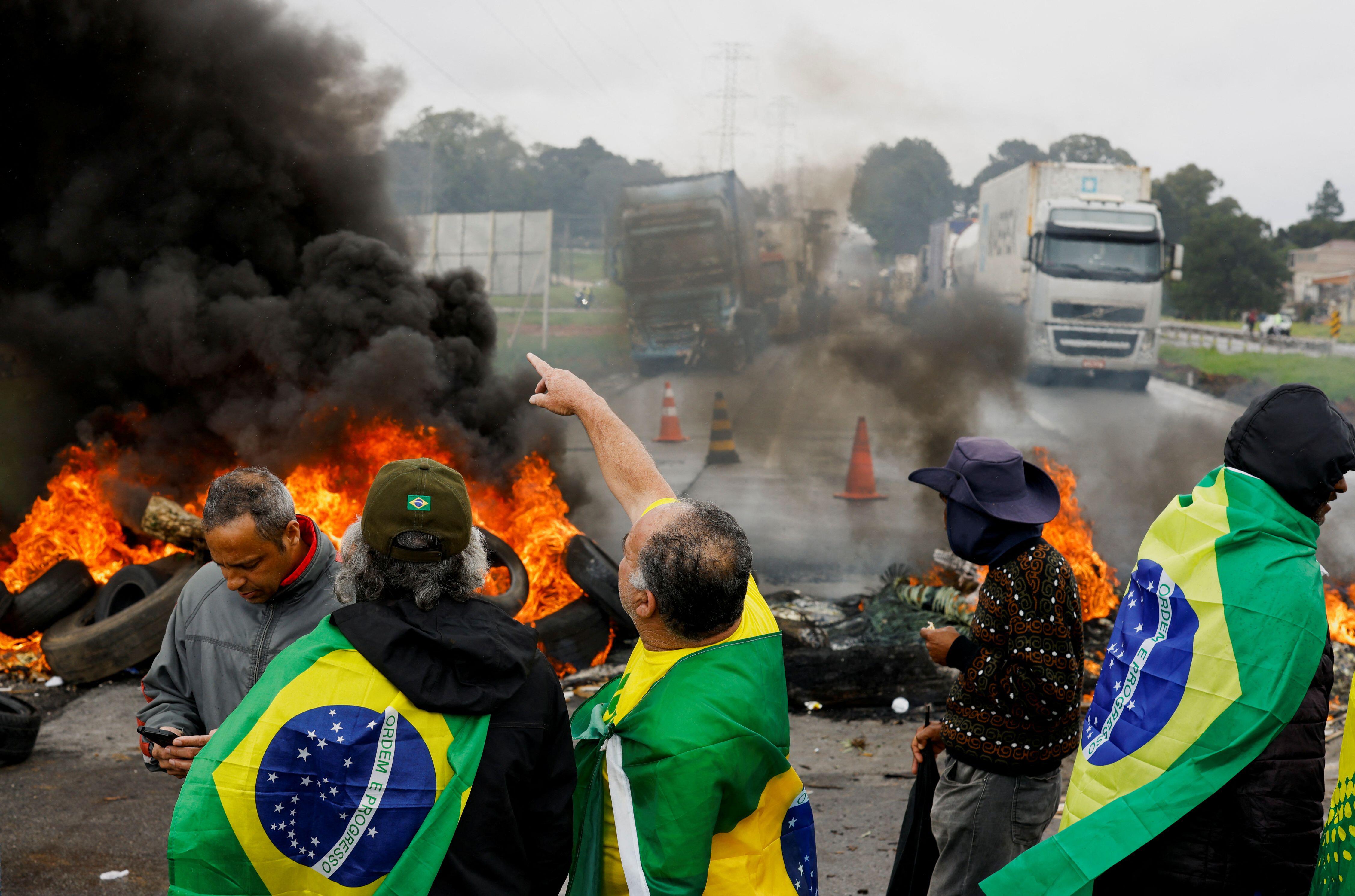
But even now, Brazil remains vulnerable to far-right forces working to crush democracy or corrode it from within.
Just this summer, Bolsonaro and seven other senior members of his government were convicted for attempting a military coup after losing the 2022 presidential election. They intended to arrest or assassinate Lula and his vice-president, as well as Supreme Court justice Alexandre de Moraes (who safeguarded the electoral process and investigated disinformation spread by Bolsonaro’s base), though their plan ultimately failed when the commanders of the Brazilian army and air force refused to be involved.
Despite their convictions, Brazil’s anti-democratic movement remains mobilised and on the prowl, supported by the US and a diverse domestic far right, with broad electoral bases.
Trump, a Bolsonaro ally, has responded to his prosecution by imposing 50% tariffs on Brazilian imports to the US and revoking the visas of eight of Brazil’s 11 Supreme Court justices. (The US retaliation has had the unintended consequence of boosting Lula’s popularity, who has been praised at home and internationally for standing up to Trump.)
And in September, Bolsonaro’s supporters in Congress tried to force a vote on an amnesty bill for the former president, who has been sentenced to 27 years in prison. While their efforts failed, they have since managed to upgrade the bill’s status to ‘urgent’, allowing it to be put to a vote in the Senate at any time. His allies are also pushing for impeachment proceedings against the judges who convicted him, while his son, Eduardo, has left his seat in Brazil’s Congress to lead a campaign in the US against his own country.
Latin America’s other leftist presidents also face bitter domestic challenges.
Over the past four years, Chile’s Gabriel Boric has stood out among Latin American presidents and leftist leaders for his respect for democratic norms and unambiguous rejection of authoritarianism, including in countries whose leaders claim to be left-wing, such as Venezuela and Nicaragua.
Boric, who heads a coalition government of left-wing and centre-left parties, has also repeatedly condemned Israeli war crimes in Gaza, supporting action against Israel at the International Criminal Court and the International Court of Justice. In September, he told the UN General Assembly: “I do not want to see [Israeli prime minister Benjamin] Netanyahu destroyed by a missile alongside his family, I want to see Netanyahu and those responsible for the genocide against the Palestinian people brought before an international court of justice.”
But without a majority in Parliament, Boric has been unable to carry out the most important reforms he had proposed. Instead, he has had to shift his agenda towards security, forced by an increase in homicides and kidnappings and heated public debate.
With a ban on consecutive presidential terms, Boric is set to leave office at the end of this year with very low approval ratings. Meanwhile, the Chilean far right, which has always been influential and has capitalised on Boric’s challenges, appears poised to take power. José Antonio Kast, the leader of the Republican Party, is among the frontrunners to win this year’s presidential election, the first round of which will take place on 16 November.
Kast has been integral to the ongoing global rise of right-wing extremism, along with Trump, Bolsonaro, president Javier Milei in Argentina and the leader of Spain’s far-right Vox Party, Santiago Abascal. He rejects sexual and reproductive rights, equality for LGBTIQ+ people and even the UN Convention on the Rights of the Child. He chaired the Political Network for Values, a platform of ultra-right politicians and activists from Europe, Latin America, the US and Africa. He is also the heir to Pinochetism, from which he has never distanced himself.
In Mexico, the region's other major democracy, the National Regeneration Movement, a populist left-wing party with little inclination towards internationalism, is serving its second consecutive term. Since 2018, it has significantly reduced poverty, and its president, Claudia Sheinbaum, is a respected figure who has managed to stand firm in the face of Trump's tariff attacks and military threats.
But the country remains mired in criminal violence and corruption within the state apparatus and has militarised public security. So far this century, more than 127,000 people have been victims of enforced disappearances.
Colombia, which in 2022 elected the first progressive president in its history, Gustavo Petro, is once again facing violence from drug cartels, paramilitaries and guerrillas. One need only look at the time and concessions it took Petro to pass a modest labour reform, which restored basic rights workers had been deprived of in 2002, to gauge the power of the right and the economic elites to block every small social advance for the majority.
Civil society resistance
Across Latin America, civil society groups, activists, and the general public are taking to the streets to stand up to state-led efforts to roll back democracy and human rights.
“Resistance today lies in society and in volunteer groups, rather than in organised social movements or political parties, which are, with a few exceptions, in crisis,” Argentine political scientist María Esperanza Casullo, a scholar of populism, told openDemocracy.
In September, tens of thousands of people in cities across Brazil demonstrated against the proposed amnesty for Bolsonaro. In Argentina, there are frequent mobilisations for better wages, pensions and health and education resources, but few are as well attended as the anti-fascist and anti-racist protest that took place in February after Milei accused LGBTIQ people of “paedophilia”.
In Peru, police violence left 49 people dead during the 2022 demonstrations against the ousting of president Pedro Castillo. Yet thousands of young people still recently braved taking to the streets to protest a pension reform that will affect the income of self-employed workers.
“The challenge is to organise this resistance, which is quite wild,” Casullo said.
Ecuador has witnessed this challenge first-hand in recent months. As openDemocracy reported this week, President Noboa’s government has attempted to brutally repress nationwide protests over the removal of fuel subsidies, detaining many protesters and accusing the demonstration’s Indigenous organisers of “terrorism”.
The Ecudorian state’s harsh response came as UN and regional human rights experts denounced such state-led attacks in a joint statement, which said they are “deeply concerned by” and “unequivocally condemn the global intensified repression of these freedoms and the use of criminalisation [...] as a tool to suppress collective non-violent actions”.
The statement adds that those who “legitimately” exercise their fundamental freedoms are frequently portrayed as “enemies, traitors, spies, terrorists or criminals [...] to justify and expand repressive practices, policies and laws”.
“We should be concerned about our democracies when civil society is attacked and demonised as an enemy of the nation, or when families and children are exploited as if they were at risk when protecting the human rights of women or other historically discriminated groups,” said Sáez of Human Rights Watch.
Sáez specialises in women’s rights and said that, in her field, “resistance is where it has always been: in grassroots women's groups organised to fight for their right to autonomy, including the right to land and the right to a dignified life and health for themselves and their families”.
In 2024, when the Argentine government drastically cut food aid, it was women organised in soup kitchens who sustained the fight against hunger. In Mexico, ‘searching mothers’ for their disappeared children are leading the fight for the right to life and justice.
“Resistance comes from women who are searching for their missing daughters and sons and who are organising to combat poverty and organised crime in their communities,” Sáez said.
But Latin America as a whole, she concluded, “is far from protected from the rise of authoritarianism”.
 Sonia Correa