

When Moni* signed the letter on 15 February 2022, she was not doing it just for herself. “No one is safe here, not even the chief’s daughter,” says the 30-year-old Wichí woman, one of 14 indigenous peoples in Argentina’s north-western Salta province.
Moni is among 170 members of the Wichí who live in Misión Kilómetro 2 (Mission Kilometre 2). They live in the shadow of Pluma de Pato (Duck Feather), a village of around 200 criollo people, who define themselves as white and of European descent. The two communities sit directly opposite one another, separated by national highway Route 81.
On one side of the road are the Wichí’s tin-roofed shacks, supported by wooden poles and walls built from scraps of plastic and tree branches, surrounded by fences made of scrap wood. Opposite are the cement and brick houses of Pluma de Pato.
Three years ago, more than 20 Wichí women from Misión Kilómetro 2 signed a public letter denouncing sexual abuses they had suffered as teenagers, largely at the hands of criollo men. Both Moni and her mother were among those who had been raped.
“Luckily, I didn't see [my assaulter] again, but my mother kept running into hers because they lived across the road,” Moni says, pointing to the entrance to the community as she herds her seven goats. On the horizon, beyond a hill covered with bushes, Route 81 can be seen. “You just need to cross it,” she adds. “It's a 10-minute walk.”

Forty years ago, Route 81 was a dirt road that was impassable during rainy seasons. Its paving represented progress for the people of Salta and the neighbouring province of Formosa. But not for the Wichí.
Since the road was paved, it has become easier for the residents of Pluma de Pato to abuse the Wichí girls and women. But it has also opened the Wichí people up to attacks from other criollos passing through the area. Route 81’s thousands of kilometres have become a no-man's land, where seasonal workers take advantage of its proximity to border crossings during the planting and harvesting seasons, and truck drivers pull over looking for Indigenous girls and teenagers.
Moni leads her goats to her family's shack. It is seven o'clock, and the evening sun bathes the land populated by pigs, roosters, chickens, dogs and more goats in golden light. Her sisters come out to meet her, and they laugh as they watch their mother feed five parrots in a bucket.
For over an hour, the family sits in a circle in the courtyard as Moni recounts what happened three years ago in Pluma de Pato. The women who signed the letter don’t want to talk any more, she says. “They regret having brought it to light. They're afraid.”

Losing their fear
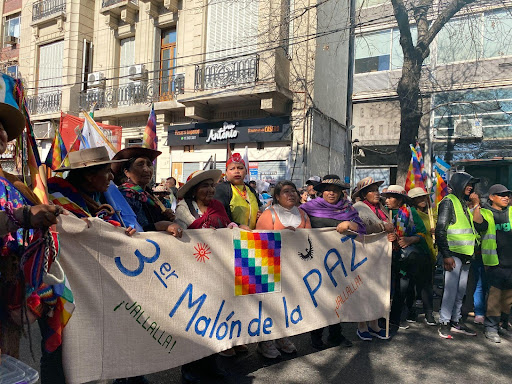
On 16 January 2022, a month before they signed the letter, Moni and other Wichí women crossed Route 81 and marched through the streets of Pluma de Pato. They walked in rows, linked together and carrying a large banner that read, ‘Justice for Pamela’.
Twelve-year-old Pamela Flores’ body had just been found lying in the grass beside the road. She had been missing for several days, during which time Moni had not slept. “She used to come to our house, we looked after her,” she says. “Now, when I see a girl on the road, I immediately think of her”.
Flores’ boyfriend, a 17-year-old from the Wichí community, was detained and indicted for the crime in 2023. But some news reports suggest her family thinks justice was not fully served, believing a criollo man was also involved and escaped punishment.
The Wichí women were fed up with seeing their daughters go missing. Before marching, they gathered and called on Octorina Zamora, a leader of Indigenous women in the area. Seven years earlier, Zamora had supported the family of Juana*, another 12-year-old Wichí girl who was killed and her body dumped on a football pitch in far north-east Salta.
Juana had gone out to buy bread with two friends when eight criollo men chased them. Her friends managed to escape, but Juana was dragged to the football field, drugged and raped. The case shocked the province. Juana had a disability and was pregnant from a previous sexual assault. It was the first case of gang rape of a Wichí girl to go to trial, with her attackers found guilty.
After Flores’ death, Zamora again took the lead. Zamora’s daughter, Tujuay Gea Zamora, who has been supporting women in the area since her mother passed away in June 2022, says: “They [the women] were determined. They wanted to take action, but they needed the strength that [my mother] somehow gave them.”

Zamora arranged for the First Assembly of Indigenous Women of Route 81 to take place on 11 February 2022, organising under the slogan ‘Nehuayiè-Na'tuyie thaká natsas-thutsay-manses’ (Wichí for ‘let’s accompany our children and adolescents’).
She called on national and provincial authorities to attend. On the day, a helicopter arrived, carrying the ministers of social development, justice, and indigenous affairs, as well as a member of the Secretariat for Human Rights, the national ombudsman for Children and Adolescents, the local police chief, and a representative of the National Institute against Discrimination, Xenophobia and Racism.
Journalists from national media outlets, who rarely visit Salta’s Chaco region, also arrived, crowding around with their cameras to cover the meeting. The Wichí women say it was the first time the media had treated them with respect, acknowledging that they’d managed to organise, march, call the meeting and bring the attention of authorities.
Until then, news reports had always portrayed the women as not being in control of their own lives, showing them with their heads bowed, walking barefoot along the dirt roads. “They had made us look like animals, like inferior beings, like people who need constant assistance and are not worthy of respect. That the best thing that can happen to us is to be part of servitude, which includes sexual servitude,” Tujuay Gea Zamora says.
The white demon
During the assembly, the women denounced neglect from the state, ranging from poor education to a lack of proper health care and barriers to the justice system. They raised a need to establish an emergency committee to address situations of violence against Indigenous children, adolescents and women.
It was not just a meeting with the authorities. The assembly provided a safe space for women to break their silence, which was as deeply rooted as the abuse itself.
Three days later, Moni and 20 other women signed the public letter addressed to the provincial minister of security and justice, Abel Cornejo, exposing for the first time the sexual violence that had marked the lives of the Wichí people for centuries. It said:
“The women who sign this letter are mothers of children born of relationships with criollo men, as they are commonly called in this area, men who do not belong to our community.
“Most are children of people who walk the streets of the town with impunity. They are the children of the first road workers who came from other provinces, the children of shopkeepers, butchers, police officers, gendarmes, teachers, nurses, and all those who at one time wanted to ‘satisfy’ their sexual desires with our bodies.”
There are 70,000 members of the Wichí across Argentina, according to the 2022 census. Many years ago, when they lived in the forest, the Bermejo and Pilcomayo rivers were their protective shield. Sheltered by the rivers’ banks, women gathered wild plants and fruits and wove with the fibre of the chaguar leaf, while men hunted and fished.
But since the conquest of the Great Chaco (a region comprising parts of Argentina, Paraguay, Bolivia and Brazil) and the 19th-century invasions that founded the Argentine nation state, the criollos have advanced on their territories and on the bodies of the women.

The men whom the Wichí women referred to in their letter live in Pluma de Pato, or once did. In northern Salta, “going out to chinear” or “to crawl” – gang raping or individually raping indigenous girls – is a legacy that the Wichí say criollos have passed on to their children since colonial times. “My mother used to tell me: ‘If you see more than two changos criollos (criollo boys), run away,’” Tujuay Zamora says.
The wichí call criollos ‘hätäy’ (white demons) and say they feel that girls, like everything around them, belong to them. Wichí women tell how criollo men and boys wait for them outside the school, chase them along the paths, trick them to gain their trust, and offer them alcohol. They say the criollos tell them not to run or be afraid or shy, and then hunt them like animals, taking them by force on motorbikes or in vans to remote areas of the village or more rugged places.
These are not unknown crimes, Tujuay Zamora says. “In the villages, everyone knows.” In groups of friends or among family members, she says, criollos joke: “Maria is pregnant. It's yours! I saw you chasing her in the woods”.
Those who should be investigating the attacks are complicit, the women say. In the Covid pandemic, two police officers in Pluma de Pato were accused of abusing a Wichí girl inside a patrol car after a man from the community filmed them on his mobile phone. The officers were removed from their posts, but neither was prosecuted.
Most of the women who signed the letter were raped when they were 13 or 14. Their complaint was not just a call for justice for themselves, but a request for reparation for the children born as a result of those rapes:
“Our children feel they don't belong anywhere, because they feel Wichí but look like criollos, which is why they are victims of cruel teasing by other children. My son asks me: ‘Why are we different?’”

The Wichí ethnocide
In Salta’s rugged Chaco region, Wichí children are born into a life of misery. Their people were once hunters and fishers, but the loss of their lands has made both increasingly difficult and cost them their livelihoods. Today, with little food and contaminated water, they face dying of hunger and dehydration.
In 2020, six Wichí children died of malnutrition in a single week, forcing the provincial government to declare a social and health emergency in the area. Five years on, nothing has changed. Children still die from vomiting and diarrhoea illnesses that, if they were in large cities, could be treated with medication or the timely arrival of an ambulance.
“The roads are terrible. The bus to the hospital runs three times a day, and the fare is expensive. People don't have money,” says Lola*, a 28-year-old Wichí woman. Lola is sitting in the courtyard of her home in Misión Chaqueña, another indigenous community near Route 81.
Metres away, Lola’s brother holds a palo santo board while her father cuts it into pieces with a saw. The family are among the few carpenters still working in Misión Chaqueña. Every year, extensive cattle ranching and soybean cultivation devour the last ancestral trees of the Wichí people. In 2024, more than 150,000 hectares of forest were cleared in northern Argentina, according to Greenpeace.
On the carpentry table are piles of forks, knives, spoons and palo santo dream catchers that the family is preparing to sell. Lola is the only one who does not make handicrafts: “I studied to be a health worker, but the chief does not support me, so for now I am a bilingual facilitator.”
Hours later, Lola provides slow translations to a woman in the only health post in Misión Chaqueña. Once a month, if local patients are lucky, the obstetrician comes to see them. Although most of the Wichí speak Spanish, the presence of interpreters helps them avoid a traumatic experience. “Many don't [seek treatment] because they're afraid,” Lola says. “If they [doctors] understood our culture, our medicines, that wouldn't happen.”

Discussing the Wichí women’s letter, Lola says: “I am supporting two girls who were abused and had children by the same rod cutter.” In recent years, she has heard abused girls say that they did not want to be pregnant. “But it is their mothers who tell them that abortion is a sin. The churches put those ideas into our heads.”
Since the early 20th century, the Wichí worldview has been permeated by Christian morality imposed by Anglican and Evangelical missionaries who arrived in the territory with their sermons.
Now, many Wichí women cannot remember their ancestral songs and the Christian beliefs have become intertwined with ideas about supposed Wichí cultural customs, which threaten to cripple the future of Indigenous children. One of the most widespread is that early sexual initiation is a Wichí tradition that must be accepted.
As a translator, Lola has heard obstetricians and gynaecologists romanticise the motherhood of young Indigenous girls as part of “their culture”, saying it “must be respected”.
But Indigenous leaders and scholars of Wichí ancestry say that neither sexual initiation nor early pregnancy is part of their community's cultural norms. Octorina Zamora repeatedly called claims that her people accept rape or child abuse “an aberration”.
“What I see is that criollos and white children have rights, and Indigenous children do not,” she said in an interview in 2012. “Don't international rights apply to indigenous people?”
Broken childhoods and adolescence
The Wichí word for ‘rape’ translates into Spanish as ‘they broke her’. A girl's small and immature body is not prepared for pregnancy or childbirth; she is at risk of high blood pressure and systemic infections, depression, and premature birth, and is more likely to give birth to a low-weight baby who will take longer to stand, talk or learn.

In December 2024, Salta province’s Ministry of Health, together with UNICEF, presented the Roadmap for Comprehensive Health Care for Pregnant Adolescents Under 15.
The protocol requires an interdisciplinary team to be immediately activated when a teenager is found to be pregnant as a result of sexual abuse, explains María Gabriela Dorigato, the undersecretary of social medicine of Salta, and Patricia Leal, the head of maternity and childhood, when we speak on the phone.
“Each adolescent is supported from the outset, advised of her rights and provided with both medical and psychological support,” Dorigato says.
But several health workers who provide medical care within Wichí communities say the roadmap is a collection of good intentions that does not reflect what is happening on the ground. “We used to have a Wichí health worker who was born in the community, but since he died a year ago, we haven't had anyone,” Lola says. “Now we have someone from Carboncito [another Wichí community] who isn't permanent but rotates.”
Local health workers also say their teams in Wichí communities along Route 81 are overwhelmed by pregnancies of young girls and teenagers.
Authorities did not respond to our request for public information on the number of health workers, obstetricians, gynaecologists, psychologists and social workers assigned to the multidisciplinary teams in the area. Yet data shows that the area has Salta province’s highest percentage of live births to girls and adolescents aged between 10 and 14, although Dorigato and Leal point out that the data does not show how many of these girls and teenagers were Indigenous.
In Argentina, voluntary abortions are available to everyone up to the 14th week of pregnancy and there are no time limits on abortions where the pregnancy is a risk for the health of the pregnant person or is the result of rape. All sexual relations with a child aged 13 or younger is statutory rape, while sexual activities with teenagers aged between 13 and 17 may be considered abuse depending on the circumstances, such as the age of the other party or if the relationship was ‘exploitative’.
The roadmap requires these teams to provide women with information on how to access abortions in their mother tongue. Yet some 95% of Indigenous women said that sexual and reproductive health teams did not speak their language, according to a survey published last year by Católicas por el Derecho a Decidir (Catholics for Choice). Almost 80% said they were not provided with information on the steps to access abortion, and 84.1% said an abortion was not available within the legal time limit.
Barriers to abortion in Salta include actors opposed to equal rights, such as churches and religious foundations, as well as politicians, judges, prosecutors, lawyers, police officers, doctors and even local authorities. In 2020, the city of Orán, one of the largest towns in Salta’s Chaco region, declared itself ‘pro-life’ – a label that, in practice, should not change access to abortion but is emblematic of the attitudes that women seeking a termination face.
The hospital in Tartagal, a city in northern Salta, has the only abortion clinic in the area that is open all year round and performs abortions on all grounds. Janet Meoniz, a licensed obstetrician, says anti-abortion actors target the hospital between 9am and 1pm on Mondays, when the abortion clinic is open.
“They are evangelists, Catholics, even hospital workers,” Meoniz says. “There is always someone there telling patients that there is no doctor and that abortions are no longer being performed.”
The clinic’s resident doctor, Araceli Gorgal, says it performed 100 abortions every month until president Javier Milei took office in December 2023. Now, it receives only 10 boxes of abortion pills each month, with each box containing only enough pills for one abortion. “We have to choose who gets them,” says Gorgal, who has worked at the clinic for four years.
Faced with shortages, the young doctor explains, they give priority to adolescents, women from Indigenous communities and women who have given birth more than once. Asked how many pregnant Wichí children or teenagers they have received, Gorgal says: “Ten, at most.” And how many said their pregnancies were due to sexual abuse? “I haven't had any cases,” she says, “but that doesn't mean it doesn't happen.”
Gorgal, who is from Buenos Aires, co-founded the University Network for the Right to Abortion, which gathers public universities’ departments on sexual and reproductive rights and health. She says her stay in Salta is helping her to break down many misconceptions she had as a white feminist from the capital. “Since I've been here, I only have more questions, and I constantly reflect on what we do and how we do it.”
Rescuing the star women
More than 140 kilometres from Tartagal, Wichí women leaders walk through La Cortada, another Indigenous community on the edge of Route 81, inviting people to a workshop at a community centre in an hour.
At midday, women begin to arrive. The gathering aims to restore the leading role that Indigenous women – ‘star women’, according to the Wichí worldview – once had in their lands. Before colonisation, they passed on the ancestral knowledge vital for the survival and development of their people.

One of the few female Wichí chiefs in the area, Nancy López, tells the women of the knowledge of life in the bush that has been lost. “We have medicinal herbs for abortion,” she says, “and herbs to prevent women from getting pregnant.” But, she explains, this knowledge must be shared in their own language. “We don't come and say let's talk about abortion, legal abortion, and that there is a right to choose. If we say it in those words, we will fail.”
Attending the meeting is Laurentina Nicacio, a 30-year-old leader and representative of the El Quebrachal community in Ballivián, south-east Salta. Nicacio talks about her experience setting up a football team for teenage girls with the help of the JUALA foundation (whose name is a Spanish acronym for United Together Against Adversity).
The team offers the girls a space to get together, play and chat. “Many of the players began to talk about abuse, doubting if it was just a bad dream. Some had suicidal thoughts,” Nicacio says. “That's why we value sentipensares, [the merge of reason and feeling] so much. The aim of sport is to boost self-esteem.”
For years, Nicacio has travelled through these lands supporting girls and women to report sexual abuse. She has survived threats and beatings. “Once they stopped me and took me away in a van, and told me: ‘Shut up or we'll make you disappear,’” Nicacio says. But she didn't shut up. “Today, public denunciation and support for people are more effective than seeking justice.”
Nicacio now believes that change will come from within the community. She chairs Ballivián’s primary school development commission. “They have made us believe that there is no other vision for the future. As if we had no other life project. That's why the only way to make things real is for boys and girls to study.”

Securing the future in exchange for justice
It has been three years since the women of Route 81 published their letter detailing their abuse in Pluma de Pato.
In the months after the assembly, Tartagal’s public defender’s office made several visits to the community to advise the women on the legal options available to them – a move that two of the office’s members, psychologist Evangelina Sandoval and social worker Paola Vargas, described as “historic and groundbreaking”.
But the few Wichí women who dared to move forward with their allegations of abuse have since come up against a wall erected by the judicial system. They report long waits in freezing rooms at police stations for an officer to deign to attend to them. In the end, most cases were not reported or were shelved without investigation.
The judiciary and the prosecutor’s office in Salta denied having figures of sexually abused Wichí children and adolescents in response to my public information requests.
Even in cases of pregnancies resulting from rape, cases have not been brought to court. “Since the Juana case, no other case has been brought to trial,” says Martín Yañez, anthropologist and expert witness in the prosecutor's office.
The women’s collective complaint exposed the criollos, accustomed to impunity, many of them well-known men who sought to hide the disgrace at any cost. Sandoval and Vargas say that during the guidance meetings, the women told them that the criollos had already begun “to distort the facts and instill fear in them”.
“The men would say to us: ‘Report me, and there will be no choice but to kill you,’” says one of the women who signed the letter. “They also offered us boxes of milk, packets of sugar, rice, money.” As well as facing threats and bribes, the Wichí women were also being forced to search their memories for what they had tried to forget for years.
Under pressure and in fear, most of the signatories of the public complaint chose not to report their abusers in court, forever banishing their chance at justice. Only four women filed criminal reports for rape, while 15 filed paternity lawsuits, assuming a consent that did not exist in order to protect the future of their sons and daughters.

“It's like a blackout, everything falls apart,” says Claudia*, one of the four women who dared to seek justice. “Since there are no answers, many say they're giving up, that they don't trust anyone anymore.”
Today, the media spotlight is gone, as are the national and provincial authorities who promised to protect children and adolescents. The women feel alone. The threats remain, as well as the contempt of some women and men in the community who cannot forgive them for speaking out. “They call us whores. They mock us because they say we haven't achieved anything.”
Of the 15 men whose paternity was claimed, eight acknowledged that they were the fathers. But only two signed agreements to provide child support: a teacher and a farm foreman, who acknowledged paternity of several children with different women. Judicial sources told me that the man asked women to have sex with him in exchange for allowing them to work as labourers on the farm he ran.
None of the four men formally accused of rape has been brought to trial. In March this year, prosecutor Lorena Martínez responded to my repeated requests for information with a brief summary of the proceedings, the latest dating back to June and August 2023. Soon after, Martínez reactivated investigations by issuing orders for DNA samples from two of the suspects, arraignment hearings and the search for a fugitive.
Martínez also travelled to Misión Kilómetro 2 to meet with the four complainants on 16 April. The last time she had been there was in 2022. Since then, the women have submitted various letters requesting information on the status of their cases, asking to be notified of hearings in advance so they could arrange their travels and their defences, and requesting that, as previously agreed, summonses not be delivered by Pluma de Pato police officers, many of whom have been accused of assaulting and revictimising women.
“I still have hope. We all have rights,” Claudia says after meeting with the prosecutor.
Route 81 crimes are not something of the past. Wichí girls are still going missing or appear lying on the side of the road, in the woods and on trails. And while justice remains elusive, Claudia finds strength in meeting other women. In building community, in looking to the future together. “Perhaps thinking about other lives is all you have left.”
*Some names and details have been changed to protect the identity of survivors and complainants. The criollos who commit sexual abuse continue to threaten anyone who files or supports a report.
This investigation was produced with the support of the International Women's Media Foundation as part of its Reproductive Rights, Health and Justice in the Americas initiative.
 Ana Fornaro
 Luciana Mignoli


