
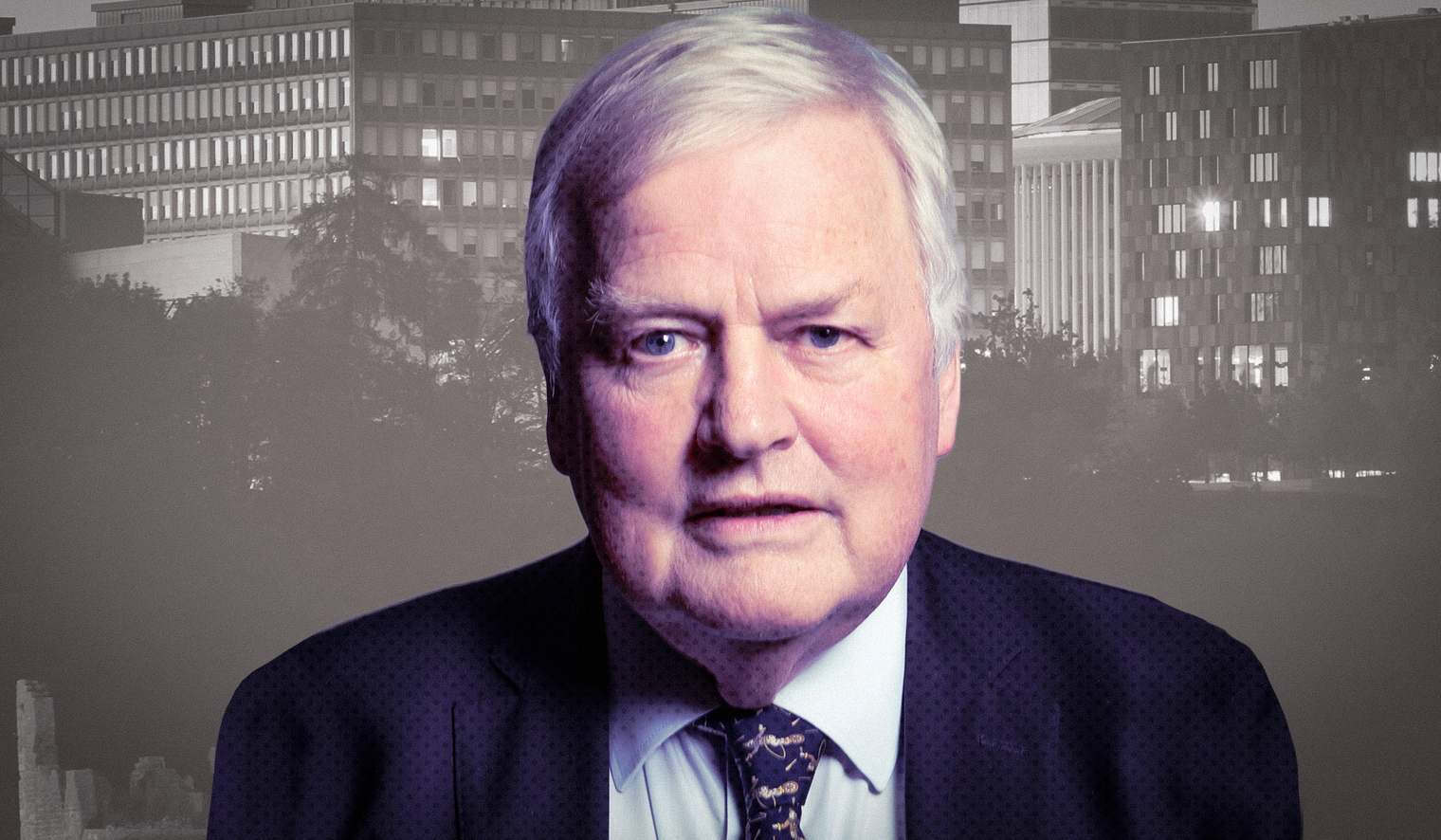
Embattled Tory MP Bob Stewart hid his directorship of a foreign defence company controlled by a controversial Azerbaijani businessman while sitting on Parliament’s influential defence committee.
An investigation by openDemocracy and the Organized Crime and Corruption Reporting Project (OCCRP) has found that Stewart failed to declare his role at the Luxembourg-registered firm.
A former member of Westminster’s standards committee said the failure “looks like a clear and serious breach” of the rules.
It comes a week after Stewart, the Conservative MP for Beckenham, was charged with a public order offence over an alleged racially aggravated incident in December.
The latest revelations centre on Stewart’s hitherto secret directorship of Ksantex SARL, a provider of defence equipment and advice, between February 2015 and July 2017. During this time, he was a member of the House of Commons defence select committee, which is tasked with overseeing the work of government on defence issues.
“It would be difficult to describe something which is more of a conflict of interest than this,” the SNP’s constitutional affairs spokesperson Tommy Sheppard told openDemocracy.
MPs are required to declare all relevant outside interests on the Register of Members’ Financial Interests within one month of election and any changes to their interests within 28 days. Stewart failed to declare his position in the two and a half years that he was a director or at any stage since.
Parliament’s own guidance states that the register’s purpose is “to provide information about any financial interest which an MP has, or any benefit which they receive, which others might reasonably consider to influence his or her actions or words as an MP”.
When asked by openDemocracy why he hadn’t registered his interest in Ksantex, Stewart said: “I believe I had already registered my interest in that group of companies in 2012.”
That year, Stewart did declare a consultancy arrangement with a separate company, VES Consultancy (UK) Ltd, where he earned £3,000 per month for the “provision of leadership/planning training and advice”. Stewart’s declaration said the work lasted for one year from 1 July 2010.
But there is no mention in the register at any stage of his two-year directorship with Ksantex SARL.
VES Consultancy (UK) Ltd, which was dissolved last year, didn’t have any obvious corporate links to Ksantex SARL, so it was initially unclear why Stewart considers them part of a “group of companies”.
But there is another significant person, beyond Stewart, who connects the two firms: a French-Azerbaijani businessman called Khagani Bashirov, who served time in jail in relation to an investigation into the disappearance of funds from the International Bank of Azerbaijan.
Commenting publicly for the first time, Bashirov confirmed to openDemocracy that he controlled both VES Consultancy (UK) Ltd and Ksantex SARL.
Shadowy connections
Bashirov was mentioned during the proceedings of the UK’s first Unexplained Wealth Order (UWO), which was brought against the wife of Jahangir Hajiyev, the former chairman of Azerbaijan’s state bank, in 2018.
UWOs hand authorities powers to investigate individuals, often corrupt foreign officials, who are suspected of having laundered stolen money through UK assets. They also ultimately ease the confiscation of these assets if the individuals are unable to explain the sources of their wealth.
In the 2018 proceedings, the UK National Crime Agency (NCA) named Bashirov as being connected to Hajiyev, who was jailed for 15 years in 2016 after being convicted of being part of a major fraud and embezzlement that saw tens of millions of pounds disappear from the International Bank of Azerbaijan (IBA).
The NCA revealed in a witness statement that Bashirov was also jailed in Azerbaijan in relation to an earlier investigation into the disappearance of tens of millions in local currency from the same bank. Bashirov served a four-month sentence from September 2010 to January 2011.
Bashirov confirmed to openDemocracy that he did spend this time in jail, but said he cooperated with the authorities in Azerbaijan and the NCA, adding that his “criminal record is clean everywhere”.
He said his relationship with Hajiyev had soured because he (Bashirov) had worked with the Azerbaijani authorities to return bank assets to the state.
“Our relationship started to deteriorate in early 2013 and totally ended in November 2015,” he said. “He told me that I had betrayed him.”
Bashirov said he met Stewart “once or twice” and hired him to help with his consultancy business.
“I wanted to start providing economic consultancy services to my clients and the presence of such a consultant could be a great help to me,” he told openDemocracy.
As an MP, [Stewart] should have declared this position. As an MP on the Defence Committee, the omission is even worse
Bashirov’s time in jail in Azerbaijan overlapped with the period Stewart worked for his company, VES Consultancy, in the UK.
Stewart confirmed having met Bashirov while he worked for the firm. “I believe I met him socially twice during my consultancy and we certainly did not discuss business,” he said.
Stewart told openDemocracy he had no knowledge of Bashirov’s ownership of VES or links to Ksantex SARL and said he would have declined the consultancy if he had known and been aware of Bashirov’s jail time.
He also said his role at Ksantex “was actually a consultant/non-executive director.” He added: “I advised on business leadership/planning based on my 2009 book ‘Leadership under Pressure’ which was all about business. But I was not in any way involved in running the company or any decisions it made. I was totally unsighted on decision-making.”
‘A clear and serious breach’
The Tory MP told this website he hadn’t known that Ksantex was involved in defence work, saying: “At the time I believed the business of the group was about construction and in no way defence-related.”
But a simple check of the company’s website would have revealed its true business. Although Ksantex currently describes itself as a “boutique consultancy firm”, it was much more explicit about its defence-related activities when Stewart was a director. An archived version of its website from 2016 says the firm offers a “wide range of technologies, tactical equipment and services”.
It also lists selected tactical equipment, encrypted technology, recording systems and UAVs (drones) among the products it sold, naming several brands and manufacturers it works with.
Bashirov said Ksantex had never sold or bought military equipment but is “a consulting company in the field of civil and military radars”. He confirmed that Stewart had been registered in Luxembourg as a non-executive director of the company.
Throughout his time with Ksantex, Stewart, a former British army colonel and UN commander in Bosnia, was an active contributor to defence debates in Parliament. He argued for greater spending on defence and secured a debate speaking in support of the regime in Kazakhstan.
Breaches of the rules by MPs can be referred to the parliamentary standards commissioner, whose work is overseen by the committee on standards.
The SNP’s Tommy Sheppard, who served for two years on the standards committee, said: “This looks like a clear and serious breach of parliamentary rules. As an MP, [Stewart] should have declared this position even if unpaid. As an MP on the Defence Committee, the omission is even worse.
“Most people will find it astonishing that an MP sitting on a committee which in part scrutinises UK government defence procurement is at the same time a director of a company which sells defence equipment and advice.”
MPs should be prevented from taking up any employment outside of their official roles
It’s unclear if Stewart was paid by Ksantex. The company accounts make no mention of him and Stewart himself was unable to clarify the situation. Asked by openDemocracy if his £3,000 per month consultancy with VES came to an end in 2011, as the register of interests suggests, or if he was subsequently paid by Ksantex, he replied: “I’m not sure to be honest. I think my remuneration lasted for two years but then they had no further need of me.”
One curious anomaly is that VES Consultancy (UK) Ltd was a dormant company during the time Stewart worked with it. Both Bashirov and Stewart described it as a “start-up”. It is unclear how Stewart was paid by a dormant company.
‘Transparency is only part of the solution’
Ksantex’s archived website said it was registered in Luxembourg, often cited as a corporate secrecy haven, but had its main offices in London and Baku, the capital of Azerbaijan. It also reported having offices in Russia, Belarus, Kazakhstan, Georgia and Moldova (as well as a branch in Kosovo), indicating that it could give “support to companies bidding into programmes in these countries”.
Although Stewart hid his role with Ksantex from Parliament, there was no hiding his parliamentary connections from Ksantex. “House of Commons” was listed as his address on his director’s registration form in Luxembourg.
The connections between Stewart and the company also went deeper than his own directorship. His business associate and now parliamentary staffer, Reza Tabrizi, took up a directorship with Ksantex on the same day Stewart did, remaining at the firm until they both resigned in July 2017.
And Stewart’s brother, Andrew, was a director and minority shareholder of Ksantex’s UK subsidiary between 2013 and 2016. He is a former sales representative for the French multinational defence firm Thales in the UK.
Rose Whiffen, senior research officer at Transparency International UK, said MPs should be prevented from taking second jobs outside of Parliament.
“MPs are elected to serve the public interest. When politicians take second jobs, especially in sectors closely associated with their parliamentary work, this could create the impression that their actions are unduly influenced by the interests of their employer.
“At the very least, MPs should always be candid about their financial interests, but transparency is only part of the solution.
“Save for a few exceptions involving public service, MPs should be prevented from taking up any employment outside of their official roles,” she said.
Links between the Conservative Party and controversial figures from Azerbaijan have been under scrutiny recently.
Last month the BBC revealed that a major donor to the Tories was a businessman whose foreign companies were part of a global money laundering investigation. And last year openDemocracy revealed that Conservative MP Bob Blackman boasted that he was “fed” propaganda by the Azerbaijani embassy and used it to lobby the UK government.


