

BELÉM, Brazil – Indigenous women who gathered at a summit on the fringes of COP30 have called on governments to end discrimination, respect self-determination and provide direct access to climate finance.
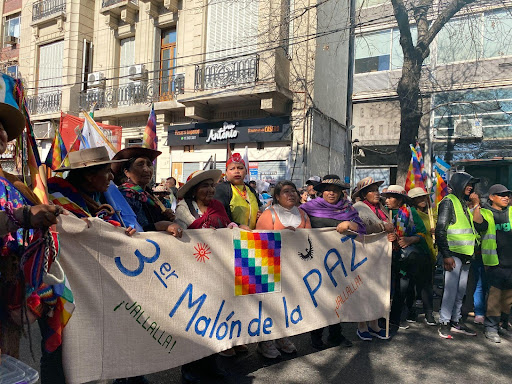
Between 12 and 14 November, 200 delegates met for the Global Summit of Indigenous Women and Youth at the Emílio Goeldi Museum in Belém do Pará, the northern Brazilian city where the United Nations Climate Change Conference is being held.
“The climate crisis is fundamentally a crisis of rights, justice and life, rooted in colonialism, exploitation and structural inequality,” reads their political declaration, which openDemocracy has obtained. “Climate finance is a right, not a favour.”
The fringe event was organised by the International Forum of Indigenous Women, a platform that brings together networks and organisations from Asia, Africa, the Pacific, the Arctic and the Americas. Some 2,500 Indigenous representatives are attending COP30, 14% of whom are accredited to access the ‘blue zone’, the official area for the intergovernmental negotiations that will continue until the 21st of this month.
Only 1.4% of global gender funds reach Indigenous women's organisations, according to the UN Permanent Forum on Indigenous Issues. The Indigenous women leaders at the summit, therefore, want to ensure they receive “direct, simplified and culturally appropriate access” to existing UN climate funding mechanisms (such as the Green Climate Fund, the Adaptation Fund and the Loss and Damage Fund) as well as places on their governing bodies.
“Our presence in these spaces is not granted, but earned through generations of struggle, resistance and organisation. Every step towards recognition and access has been the result of our persistent efforts to raise our voices and defend our rights,” the political declaration states.
“Therefore, climate finance must be directly accessible to Indigenous Peoples, Women and Youth through mechanisms under our own governance, ensuring that resources are aligned with our priorities, values and visions of climate and territorial justice.”
The declaration also calls for the 2022 General Recommendation No. 39 of the UN Convention on the Elimination of Discrimination Against Women, which focuses on the rights of Indigenous women and girls, to be effectively implemented with measures that are culturally appropriate and accessible. This is particularly important as many Indigenous people speak only their language and are excluded from information and education.
“Women are the first to suffer from the ecological crisis and climate change,” said Sonía Guajajara, an Indigenous activist and Brazil's minister of Indigenous peoples, at the summit’s opening. “Fires and extractivism are destroying their traditional medicines, crops and animals, leaving them cornered and under pressure from a capitalist system that does not respect their ways of life, their connection to the environment or their ancestral practices,” added Guajajara, who is a member of the Guajajara people.
The minister mentioned the drought affecting Amazonian rivers, exacerbated by forest fires and deforestation, which in recent years has left numerous communities isolated and unable to move. “These droughts mean, for example, that children cannot attend school,” she said.
Although this global summit took place within the framework of COP30, the conversations and discussions expanded to include historical issues that transcend generations and territories, such as physical violence, racial discrimination, lack of access to education, access to information and economic independence.
Tarcila Rivera Zea, a member of the Quechua community in Peru and the executive president of the International Forum of Indigenous Women, called for a discussion of the violence generated by climate crises. “In the Andean region, if it doesn't rain, our crops die, as do our animals,” the activist, who has been defending the rights of Indigenous women for more than 50 years, told openDemocracy.
“Then, the community and family structure that depends on the land falls apart, because the men go out to work for very little money, and the women are left with the burden of working the land, which becomes more difficult, and caring for their children. Climate change generates more poverty and breaks down community structures”, she added.
Unlike in the Peruvian Andean region, the Amazon can be felt at every turn in Belém, which spans the mainland and more than 40 islands in the Guamá River and Guajará Bay. The 80% humidity makes the city’s heat more intense and its 1.3 million residents say temperatures are getting higher and higher. In many areas of Belém, there is no drinking water or proper drainage systems, which leads to pollution in the rivers, with vulnerable communities most affected.
Kenyan leader Eunice Chepkemoi, visiting the Amazon for the first time, told openDemocracy about the reality of her Ogiek community, whose ancestral territory is in the Mau forest in the south of the country. The 20,000 Ogiek people live off honey production, but intense deforestation is causing the bees to migrate to other forests. “Our government does not recognise our ancestral rights, nor does it respect our territories,” Chepkemoi said. “It expels us in order to commercialise the timber.”
Regarding the official climate negotiations, Rivera Zea said: “We are not here to ask for a seat at the table. We are here to remind everyone that the Earth is already speaking, and many of its voices are those of women.”
Some of the Indigenous women’s proposals seek to turn their experiences into concrete solutions for adapting to the climate crisis. For example, community science, which prioritises the knowledge, concerns and observations of the community, is not only a valid tool, but a real means of adaptation.
The document also insists on the need for climate justice with a gender perspective. This is no minor detail – forests under Indigenous governance experience 60% less deforestation, and women, accustomed to care work, are mostly responsible for the restoration of these ecosystems, according to the World Resources Institute, a global research non-profit organisation.
An inspiring example comes from the women of the Otomí people of Mexico, who maintain a network of sacred hills, where pilgrimages combine spirituality, reforestation and protection of water sources. Similarly, networks of Amazonian women in Ecuador and Brazil are mapping the spiritual and ecological links of the territory to guide conservation based on traditional knowledge.
The challenges are many, but so are the proposals. In the coming days, we will see whether the official delegations listen to the voices of those who have inhabited and protected the rainforests for centuries, or those who exploit them as commodities.
 Ana Fornaro
 Paul Rogers


