
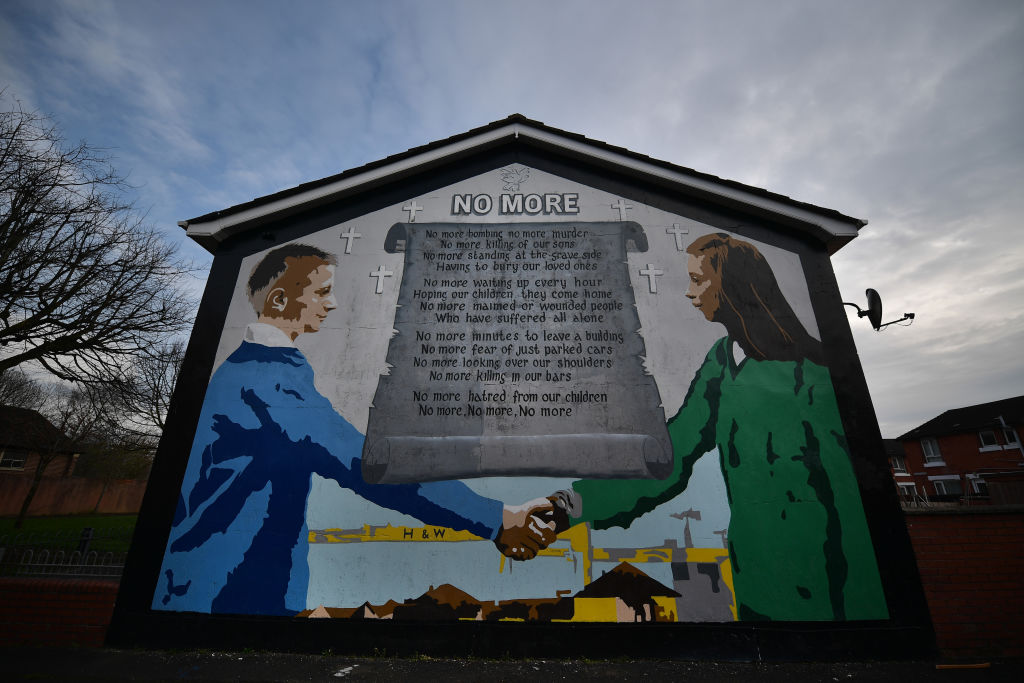
For decades, peace in Northern Ireland appeared unattainable to some and unimaginable to others. That changed 25 years ago, when, after years of negotiations, a landmark peace agreement brought the 30-year conflict to an end.
Today, the North has plenty to celebrate, but has the Good Friday Agreement truly been the resounding success its architects portray it as? Or has Northern Ireland’s peace process faltered on delivery?
There can be no question as to whether or not the Good Friday Agreement – signed on 10 April 1998 and then ratified by referendums a month later in Northern Ireland and the Republic of Ireland – saved lives; there are many who are here today as a direct result of it.
But while ending large-scale violence remains its greatest achievement, realising reconciliation remains an elusive aspiration. If the accord was intended to achieve a ceasefire, it has been a resounding success. But if, as advertised, the objective was to bring about peace and prosperity in Northern Ireland, its implementation leaves much to be desired.
Much of the Good Friday Agreement was rooted in the conditions of a ceasefire: decommissioning, security, policing and justice, and the early release of prisoners – on which there was a clear and consistent focus in the years immediately after 1998.
But although by 2003 both the British and Irish governments recognised that implementation of the agreement was slow, efforts to address this remained focused on elements of a ceasefire, namely the disbandment of paramilitaries.
Twenty-five years on, this was a demonstrably unsuccessful aim. A security assessment leaked from MI5 and the Police Service of Northern Ireland in late 2020 showed that loyalist paramilitaries are actively recruiting with an estimated 12,500 members.
Policing reform, the release of prisoners and decommissioning were all achieved to varying degrees of success, but what of human rights and equality? Promises to this aim are threaded throughout the agreement: a Northern Ireland Bill of Rights, incorporation of the European Convention on Human Rights (ECHR), a Civic Forum. But of the many commitments made, only the incorporation of the ECHR has been effectively delivered.
The right to choose one’s place of residence is one of several commitments the deal made under ‘Rights, Safeguards, and Equality of Opportunity’. Yet social housing remains 90% segregated along historically divided community lines, and between 2015 and 2018 alone, more than 2,000 cases of intimidation and people being driven from their homes were reported by Northern Ireland’s public housing authority, with two-thirds attributed to paramilitary threats.
Similarly, the peace deal commits itself to the right to freedom from sectarian harassment. But signs calling for lethal violence against Catholics, or even their total extermination, can be seen mounted on bonfires on an annual basis, burning alongside Irish flags and human effigies.
70% of pupils in Northern Ireland attend schools where there is less than a one-in-20 chance of meeting a pupil from another religious background
Delivering peace entails much more than simply facilitating an end to violent conflict. Peace is built and sustained by economic prosperity, stable government, and social cohesion – yet measures to desegregate Northern Irish society have been poorly implemented.
Integrated education makes up only 7% of the region’s available schooling options, with 70% of pupils attending schools where there is less than a one-in-20 chance of meeting a pupil from another religious background, according to analysis from the Northern Ireland Council for Integrated Education. Segregating children along religious lines from the age of five is reported to cost taxpayers £226m a year because of the duplication of transport and education services.
Deeply fragile
Peace agreements require constant care, review, effective monitoring and implementation. After 1998, complacency set in on behalf of the governments and political parties and there was steady and significant political drift. Efforts to deliver on the most fundamental aspects of building a sustainable peace have faltered.
Northern Ireland’s peace process is stagnant and deeply fragile as political instability continues to grow. Without intervention by the Irish and British governments – the two most pertinent co-guarantors – this peace will not be allowed an opportunity to flourish and, more disturbing a prospect, may even slide further backwards.
The most glaring mistake, with the benefit of hindsight, was the lack of an effective implementation strategy reinforced by timelines and external monitoring. But this oversight can still be rectified by the establishment of an implementation committee involving Irish, British and US counterparts.
They would be tasked with reviewing the implementation and setting out an ambitious strategy for delivery on the many outstanding issues. We need to jolt some life back into this process.
The Good Friday Agreement is not the finished structure, but the scaffolding designed to hold a rights-based society together. As peace-builders, we have an enormous responsibility. It is up to us to ensure that even the smallest bolts are inspected and properly fastened – but to do so, we must first identify the most overlooked points of weakness.


