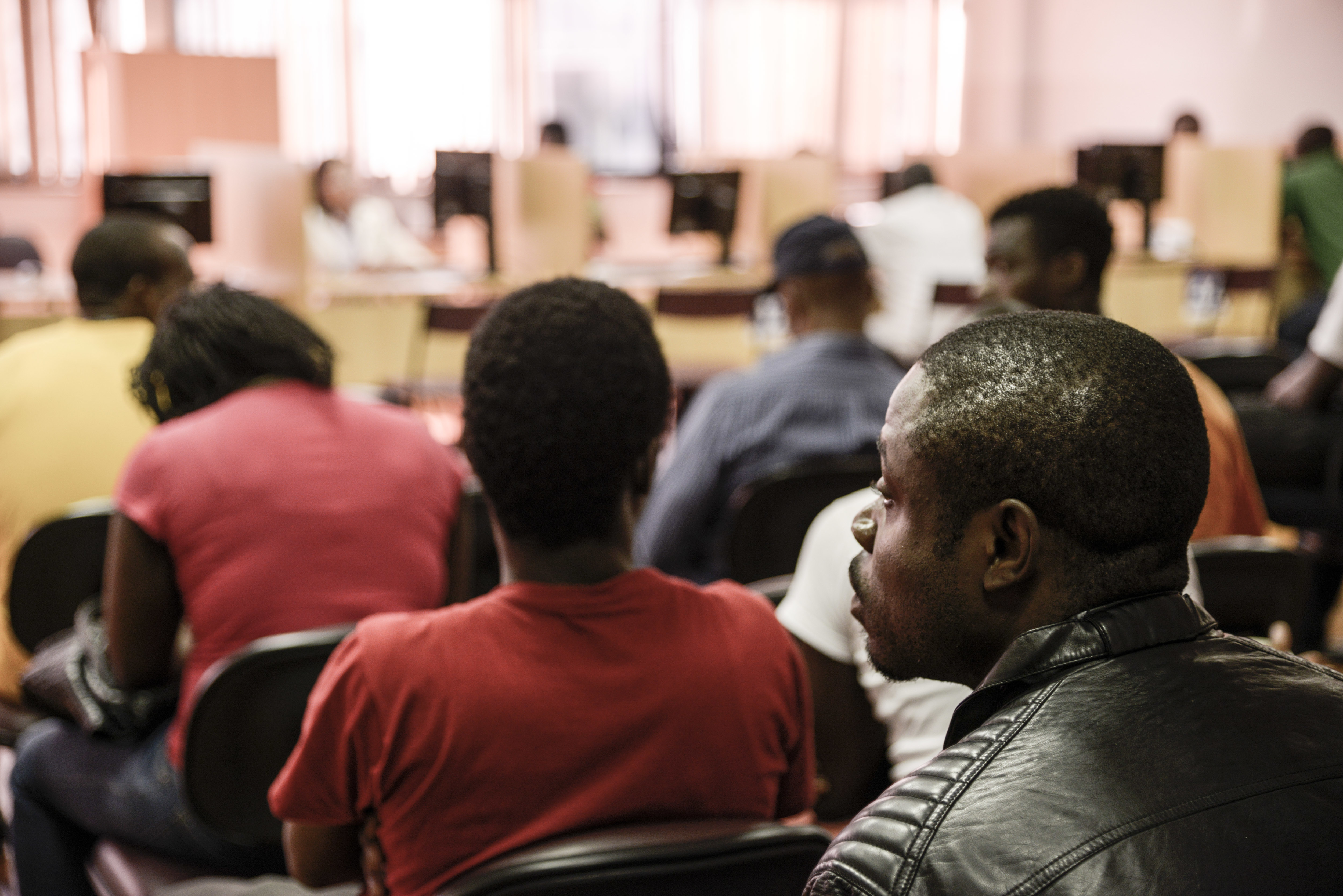
Brazil's legislation offers protections to refugees and migrants that aren’t available in many other countries. However, many migrants – particularly those from Sub-Saharan Africa – still deal with widespread racism and xenophobia. Racist attacks have claimed the lives of people seeking safety in Brazil, and there have been several tragedies in recent years. In 2022, a young Congolese man called Moïse Kabagambe was killed at a kiosk in Rio de Janeiro. In 2020, an Angolan man called João Manuel was stabbed in São Paulo. These killings have shaken the migrant community in Brazil, and many live with the constant fear of harassment and attack.
You're discriminated against by the people who should protect you
“I never go out without a document. You don't know what will happen. You arrive at an institution like the federal police, which you expect to be free of racism and xenophobia, and you are discriminated against by those who should protect you. They know you don’t speak the language, but they don’t care. They talk to you, and if you don't understand what they say, they start swearing and calling you names. They should use translators rather than humiliating you, or saying things like ‘go back to your country’, or ‘sit there n***, if you have nothing to say, no one will listen to you’. This happened to me! That such things are said in a federal police station shocks me a lot.”
Racism is everywhere here
“We live with racism here. Getting on the subway, for example, you feel it. You put your hand on that iron bar that people hold onto while standing up, and the person next to you takes their hands from the bar and moves away from you.”
The police ignored my report of hate speech
“Sometimes you enter the mall, or you enter a store, and you can tell they think you're not going to buy anything. They think you're going to steal something. They stare at you and pull a face. I once tried to report to the police that I was called a monkey, but even the military police told me: “hey, you're living here as a favour”. So now I just answer: ‘monkey talks to monkey, right?’”

I don't want to go to the police
“I don't think about reporting racism because I don't like going to the police station. I don't want my name known there. Instead I try to protect myself, and I pray to God for protection against everything – including racism and xenophobia – so that nothing will come my way.”
Racism has become normal
“I remember that once I got lost on my way to Brás [a commercial district in São Paulo]. I went to ask a woman for information, but she just freaked out and ran away. I was like, what happened? I hadn’t even finished saying good afternoon and she was already running away. We live every day like this. This is not normal, but it happens so often that it has become a normal thing for us.”
I had to remain silent
“Brazil is a country where you see racism everywhere. Imagine what the situation is for a black and foreign woman refugee. I used to work at a school. One day, the school director himself started to discriminate against me. He started calling me a ‘prostitute’, a ‘slut’. Five people witnessed it, and one of my Brazilian colleagues called the police. We went to the station, and there they asked for my documents. I had the protocol document, but the officers didn’t know what it was. The whole thing shifted to whether or not I had a document. I had to remain silent, indignant but quiet, because for them I had no document. Nothing happened to the director.”
It was out of the blue
“I was on the street, when suddenly a teenager walked up to me, slapped me, and called me a monkey. Out of the blue! I was in shock. I thought, ‘man, what world is this?’"
To accompany this series, Missão Paz has also produced a legal support guide for migrants in Brazil. It offers helpful advice on a range of topics – from rights and immigration status to dealing with xenophobia, racism and hate crimes – as well as contact details for migrant support services in the country.