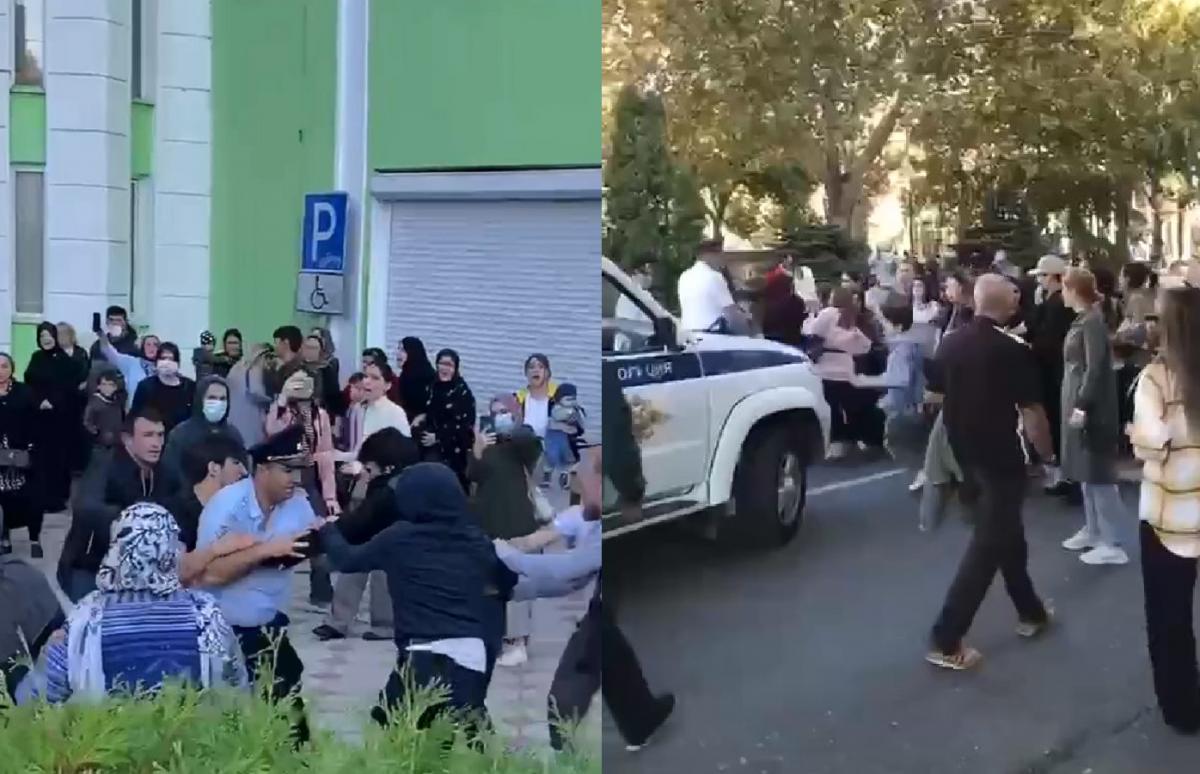
On 29 October, hundreds of men gathered at Makhachkala airport in Dagestan, a diverse republic in Russia’s North Caucasus, to target Jewish passengers arriving from Tel Aviv. Footage of the incident, featuring protesters waving Palestinian flags, making antisemitic chants and surrounding airplanes, has divided public opinion in Dagestan.
For many, these actions – as well as other recent antisemitic protests in Dagestan and elsewhere in the North Caucasus – are criminal, stupid and shameful. Personally, I was appalled at the aggression and cruelty on display. Other Dagestanis think these actions are the result of the local authorities’ ban on protests expressing solidarity with Palestine.
But there’s also a sense of déjà vu.
Acts of aggression against groups perceived as ‘enemies’ by some of Dagestani society have taken place before in the republic. Radical groups of conservative Muslim men who see liberal values as a threat have targeted singers and feminists. Concerts and festivals have been cancelled because of threats from extremist groups using similar methods to the crowd at Makhachkala airport. They also shouted insults, banged on doors, and beat the people they were targeting.
Such incidents have been met with impunity.
Radical groups have also made statements about the way tourists visiting the republic must dress and have harassed visitors whose behaviour they deem to clash with local traditions – leading the republic’s Ministry of Tourism to issue recommendations for visitors on appearance and behaviour.
For those perceived as violating local traditions or showing dissent, life in Dagestan has become dangerous. Feminists, human rights activists, journalists and individuals who could be targeted by so-called ‘honour killings’ have had to flee the republic.
Such violence in Dagestan – including the recent antisemitism – seems strange when Dagestani society is so multicultural. Jewish people are officially recognised as a historic minority in Dagestan; Mountain Jews, or Caucasus Jews, who are the descendants of Persian Jews from Iran, have lived in the Caucasus since the fifth century. Today, more than 3,000 Jews live in the republic and synagogues have been built in several cities. There have never been serious conflicts between Jewish Dagestanis and others with different ethnic backgrounds.
But in the past 30 years, an increase in socio-economic problems facing Dagestani society has led some to search for ‘enemies’. When interviewing people in the republic about politics in recent years, I’ve noticed an increase in claims that Jewish people are to blame for the ills of the country, region and people. This climate of discontent has seen the birth of antisemitic conspiracy theories, in which locals have, on occasion, claimed senior Russian and Dagestani politicians are Jews. But these discussions were held in private. Recent events show how dangerous they can be when made public on social media.
Recent decades have seen an increase in radical Islamisation in the North Caucasus – particularly in Dagestan – amid a lack of social, economic or political prospects, and Russian security forces’ violent overreach. In this context, radical ideology has been appealing to disenchanted young people, offering a different route from the failed Soviet experiment, attempts at democratisation and ethnic nationalism.
The Dagestani authorities have adopted harsh policies to enforce deradicalisation – passing laws against radical Islamists, making police registration mandatory for suspects and conducting counter-terrorism operations. This led many radical Dagestani Muslims to leave the country and go to Europe, Turkey or Ukraine. A small number joined the ranks of ISIS in Syria and Iraq. Some have gone into hiding. Since 2022, social media accounts run by Dagestanis holding extreme views (many of whom have migrated) have gained in popularity.
The Telegram channel Morning Dagestan (Utro Dagestan), which shared details of the flight to Makachkala from Tel Aviv to its 50,000 followers, is one of them. This channel, and others like it, exposes the profound problems of social justice in the republic while promoting conservative religious ideas. In recent weeks, Morning Dagestan has constantly repeated information about the tragic situation in Palestine, playing on the emotions of Dagestanis and Muslims, accusing them of indifference and calling on them to take action. This was supported by images showing dead Palestinian children, destruction caused by Israeli shelling and the alleged number of victims of Israel’s counter-attack.
Morning Dagestan – which has been linked to Russian exiled politician Ilya Ponomarev, although residents of the republic are unlikely to have known this as it isn’t branded as such – and several other channels have also begun to share antisemitic rhetoric. They suggested Jewish people could take over Dagestan and the North Caucasus, and encouraged their followers to check hotels to find out whether they were housing Jewish people. Several channels with large followings began to call for violence and collective action. These calls led to antisemitic riots on 28 and 29 October, including the storming of Makhachkala’s airport.

Here, it’s important to note that Dagestani authorities have banned all rallies that are not initiated by them, including those in support of Palestine since 7 October, which are dispersed by local police when they take place. This means that Dagestanis sympathetic to the Palestinian cause have not been able to express their support.
Even after the unrest, many Dagestanis have told me they had been expecting the republic’s authorities as well as its main mufti to express support for Palestine.
No measures were taken to stop the 29 October gathering. The republic’s authorities regularly restrict internet access in the region when they deem there is a threat of unrest, but on this occasion they did not, despite Morning Dagestan being a popular channel. Similarly, no action was taken by the police after the antisemitic protests began at the airport, or when mobs started searching hotels and private houses.
This raises questions over whether this failure by Dagestan’s authorities was negligence, a failure to take antisemitism seriously, an interest in identifying members of protest groups, or an effort to allow rioters to let off steam on a subject that has little to do with local politics.
The Dagestani authorities have so far limited themselves to blocking Morning Dagestan and condemning the behaviour of protesters at the airport. Their inaction at every stage has had catastrophic consequences. The angry crowd has brought shame to Dagestan and disrepute to the Palestinian cause, which the mobs’ actions wrongly equated to antisemitism.
The shame is compounded by the fact that so many appear to have forgotten about hospitality – a key value of Dagestani society, where you should help anyone who seeks help regardless of personal beliefs and resentment.
Since then, an investigation on a charge of “mass unrest” has been opened, but it’s not yet clear whether it will lead to mere fines or prison sentences for the accused. So far, the Russian foreign ministry spokesperson has claimed the unrest was planned from abroad.