“I will have to leave this country,” Natalia*, a human rights lawyer, told openDemocracy. “Otherwise, there will most likely be legal consequences for me because what I’m doing can ‘spread banned propaganda’.”
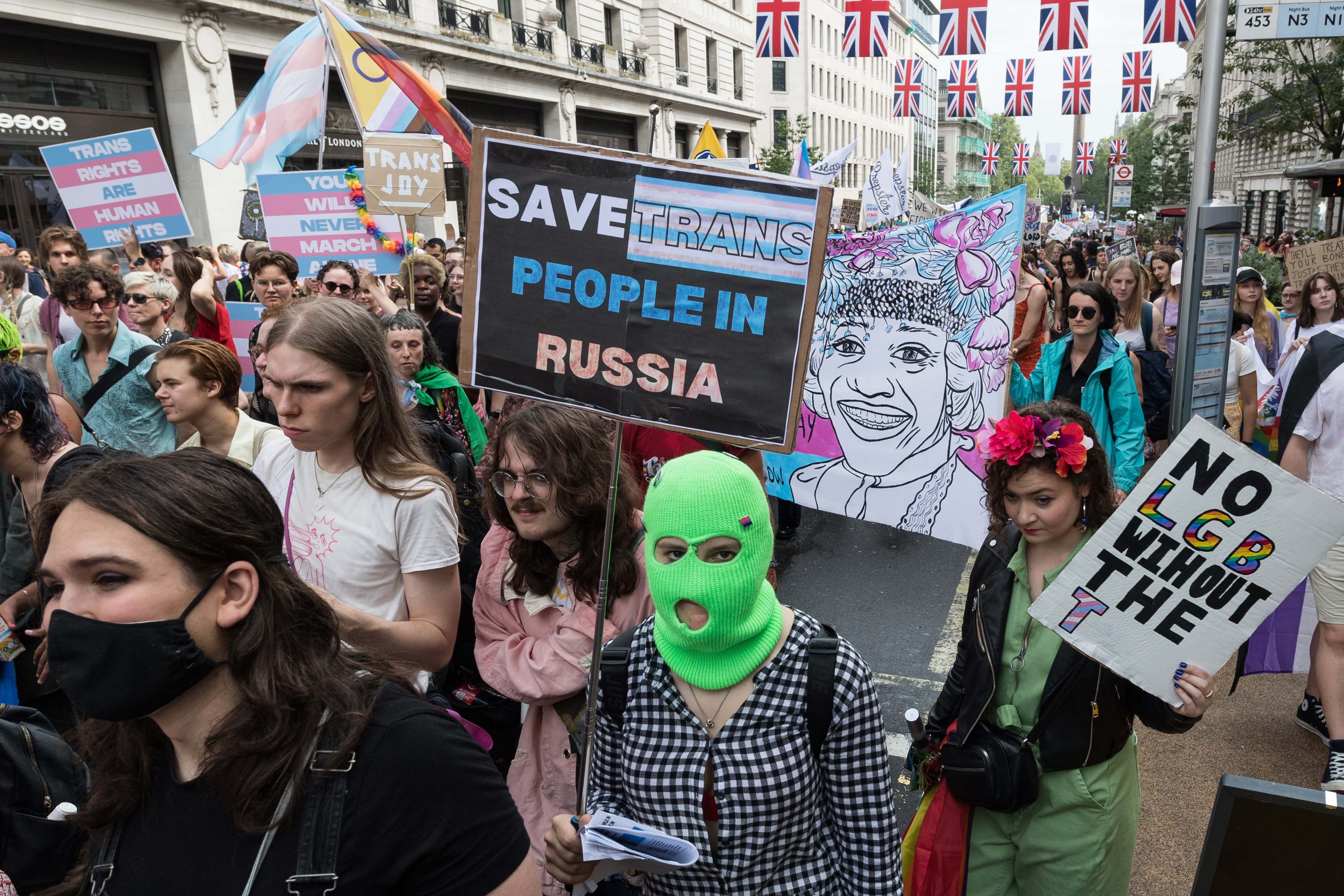
Natalia is among the hundreds of thousands of trans people in Russia who face a choice between fleeing their home country or living with severely restricted rights after Vladimir Putin signed a new anti-trans law on 24 July.
The law, which violates the World Health Organisation’s recommendations for LGBTIQ people, bans sex-reassignment surgeries, gender-affirming hormone replacement therapy and legally changing a person’s gender on official documents such as birth certificates and passports.
It also dissolves the marriages of Russian citizens who have previously legally and/or medically changed their gender and bans them from adopting or fostering children.
“Now, the trans community have their backs up against a wall with [few to no] options,” Dilya Gafurova, the director of the Charitable Foundation Sphere, the largest Russian LGBTIQ fund, told openDemocracy.
The draconian ban is also expected to punish any doctors, psychologists, endocrinologists or lawyers assisting trans people with accessing gender-affirming healthcare – though it’s still unclear how, Russian LGBTIQ activists told openDemocracy.
“There’s no specificity of sanctions against professions breaking the law, it’s implied they shouldn’t. There are multiple laws like that when it implies that otherwise their licence will be taken away,” said Gafurova.
While there is no official data on how many trans people currently live in Russia, some Russian trans rights organisations have estimated there could be more than two million, using figures from the LGBT+ Pride 2021 Global Survey by Ipsos, a multinational market research firm.
At a plenary meeting to discuss the law last month, deputies in the State Duma, the lower house of Russia’s parliament, falsely equated transgenderism “as the reason for evading military service” and accused the “Western transgender industry” of “infiltrating” Russia’s traditional and family values.
The law clarifies that the ban does not apply to medical interventions for children born intersex. But medical professionals and intersex people have strongly advised against medical procedures that aim to ensure an intersex child conforms to a particular sex assignment, with a Human Rights Watch report finding that the “results are often catastrophic”.

Rushing birth certificate and passport changes
Before the new law was passed, trans people in Russia could legally change their gender markers if they had undergone state-certified sex-reassignment surgery.
In recent weeks, many trans, intersex and gender non-conforming people rushed to amend their official documents, as applications submitted before the law came into effect technically must still be processed.
But few, if any, have been successful, according to several Russian trans activists and lawyers, who told openDemocracy that stalling by civil registry offices is to blame.
“In [more rural] regions of Russia, people for sure faced trouble changing their gender markers on their documents,” Gafurova said. “Even though they paid the fee and gathered all of the necessary documentation, they were still turned down [without any valid excuse].”
The Charitable Foundation Sphere is planning on representing these people in court, she added.
Robert Lebedev, a trans man and activist at Delo LGBT+, a legal advocacy group of LGBTIQ people in Moscow, says the decision to finally change the gender marker on his passport has been forcibly taken away from him by the Russian government.
[Until the state] imprisons me or kills me, I will stay here and continue my workRobert Lebedev, Russian trans activist at Delo LGBT+
“It makes me frustrated and angry because it wasn’t my decision not to change my documents,” Lebedev told openDemocracy. “Somehow, someone just decided this for me against all logic, human empathy or even [by medical terms], just because they can. Just because they want to discriminate against someone.”
Despite no longer being able to amend his legal documents or acquire sex reassignment surgery in Russia, Lebedev has no plans to leave the country.
“[Until the state] imprisons me or kills me, I will stay here and continue my work,” he said.
Though he understands and supports trans people who need to emigrate because of their now legally persecuted status, Lebedev worries about their decision to leave Russia.
“If you don’t have a good education or if you’re not fluent in the language, we will be even more marginalised as refugees,” Lebedev said, referring to 21-year-old Khina Zakharova, a trans woman who died by suicide in March in a refugee camp in the Netherlands after fleeing Russia.
In any case, there are limited visa-free destinations for Russian passport-holders due to European sanctions against Russia over its invasion of Ukraine – and even fewer LGBTIQ-friendly countries to move to.
Centre-T, a trans medical, legal and psychological support group in Moscow, has already started planning support programmes for trans people wanting to flee Russia.
“I’m actually planning to emigrate, because I just can’t stay here in Russia,” Maxim Goldman, Centre-T’s director of internal communication, told openDemocracy. “I understand that in a safer environment I can do more.”
Human rights will only get worse in Russia
The Russian state media surveillance entity Roskomnadzor is suing Centre-T and threatening to block its website, with the first court hearing held on 24 July, according to Centre-T’s Telegram channel.
As with most Russian-language LGBTIQ websites, Centre-T has already been labelled a ‘foreign agent’ and forced to display an ‘18+’ label. The organisation maintains that even if the state blocks its website, it will still be accessible via VPNs as the server is hosted outside of Russia.
Lebedev said Delo LGBT+ is anticipating that some trans people will start seeking hormone replacement therapy drugs on the black market. “It will be low-quality medicine; their health will be severely damaged and their lives will be much shorter than they could be,” he said.
Goldman believes trans people will not be the Russian government’s only target.
“Now they’ve [targeted] our people, but next, they’ll [target] women, for example,” he said. The Russian Ministry of Health is already reviewing a law that would restrict access to abortion.
“I’m scared that this law [is a bad omen], that everything will only get worse from here,” said Natalia, the trans human rights lawyer. “I simply do not consider being in this country safe, unfortunately, for any [LGBTIQ people].”
A Russian health ministry order that came into force earlier this month enlists so-called ‘sexologists’ in Russian clinics to provide conversion therapy to LGBTIQ people, or medical treatment to “people suffering from mental disorders associated with sexual development and orientation, disorders of gender identity and sexual preference”.
The order adds that these ‘sexologists’ have the right to use “coercive measures of a medical nature” with a psychiatrist when treating LGBTIQ people. The order was first published in November 2022, while the law banning the spread of so-called ‘LGBTIQ propaganda’ among all ages was still under consideration. The anti-propaganda law was enacted last December.
“Compulsory psychiatric treatment is a tradition that was left in the Soviet Union,” Natalia said. “Our country now wants to adopt this experience again. Therefore, I simply do not consider being in this country safe, unfortunately, for any [LGBTIQ people].”
* Natalia requested openDemocracy omit her surname for privacy and security reasons