
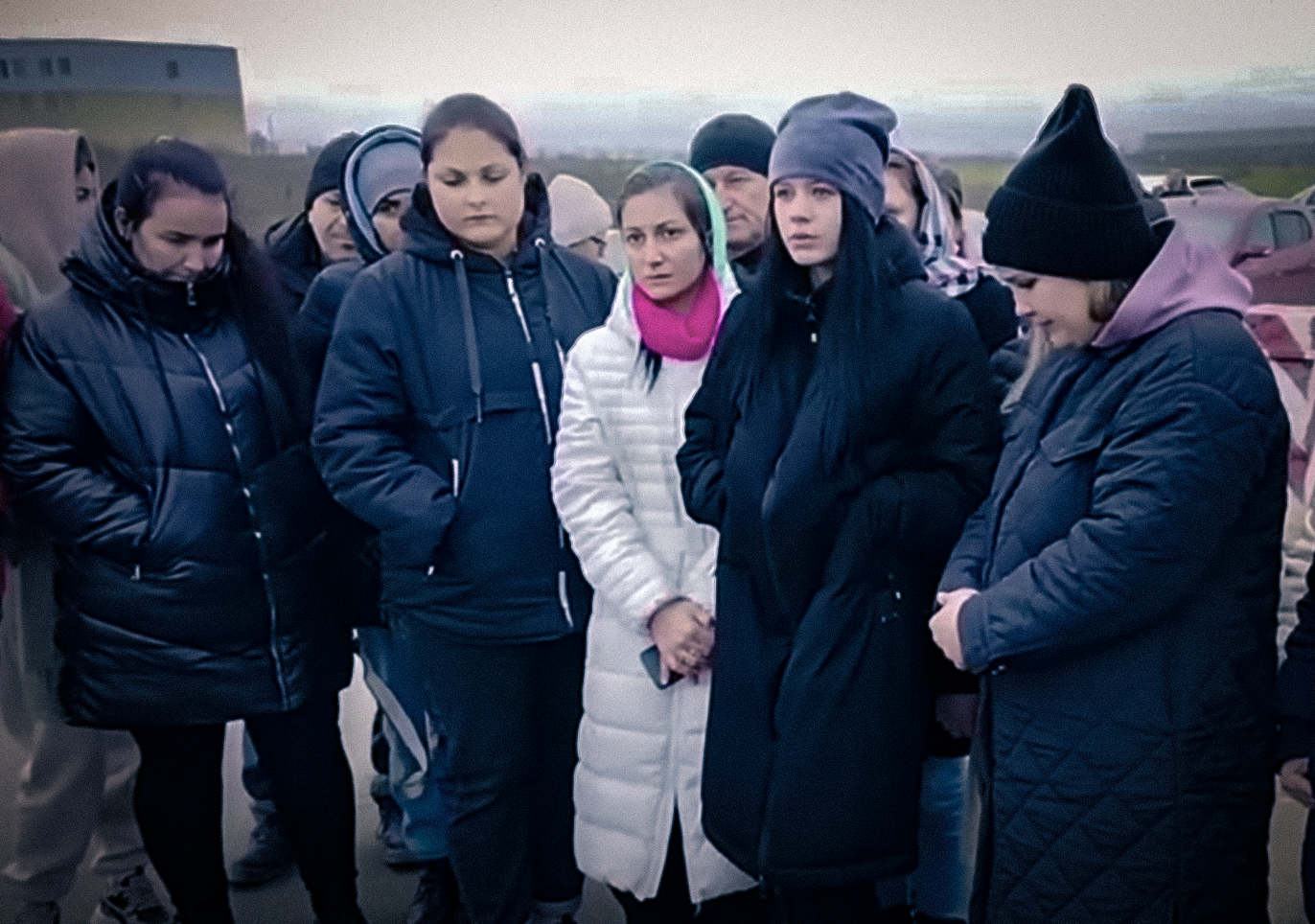
The women in Russia’s military families are posing a subtle but significant challenge to Vladimir Putin’s handling of the war in Ukraine by engaging in a form of political activism best described as ‘patriotic dissent’.
When Putin launched his full-scale invasion in February 2022, many expected the mothers of Russia’s soldiers to be at the forefront of anti-war street protests, based on their activism during Moscow’s previous wars in Afghanistan and Chechnya. Some soldiers’ mothers have expressed opposition to the war and participated in public protests, but for the most part their responses are more complex than straightforward condemnation – or support.
The mothers and wives of Russian servicemen are using patriotic dissent for their political action because they are enmeshed in a complex relationship with the Russian state and its military power, which in turn reflects the fraught relationship that the country’s citizens have with military service.
On paper, Russia recruits its armed forces via a combination of universal male conscription (12 months, obligatory for all men aged 18-27) and voluntary service. In practice, conscription has been easy to evade if the conscript or his family have the means to pay a bribe, the political connections to gain an exemption or the motivation to exploit legal loopholes that will allow him to pursue other, more attractive opportunities. The partial mobilisation announced in September 2022 did not change this established pattern of military recruitment.
The men most keen to join up are predominantly from areas of severe economic deprivation or from the most disadvantaged groups of the population, including former or current prisoners. The army is seen as an alternative to poverty or crime; it offers a steady income and the prospect of an honourable career. Further, the connection between masculinity, patriotism and military service – largely discredited among the country’s urban middle class – continues to hold sway in these communities.
Our research into the responses of the mothers and wives of Russia’s soldiers to the war in Ukraine is based on in-depth analysis of Russian state-controlled newspapers (both national and regional) and Russian independent digital media (Meduza and Mediazona). It reveals that while these women are heavily dependent upon the state, they are not silent, passive figures who unquestioningly accept the sacrifice of their male relatives to injury or death.

On the contrary, they are both active and vocal. When the Russian Ministry of Defence fails to provide even the most basic information about their family members, they self-organise. They use social media to spread news about the location of units and soldiers deployed to Ukraine. They approach Russian state authorities directly, notably through letter-writing campaigns but also by recording videos and sharing them on social media.
They appeal to the state to facilitate prisoner-of-war exchanges, locate missing soldiers, and improve medical and welfare support for those who have been injured. Even when a soldier is killed, his female relatives often must plead with the state to locate, transport and deliver his body, and to fulfil its own legal requirements to provide welfare for his family.
Through these appeals and complaints, the women seek to ensure the welfare – and chances of survival – of their sons and husbands. They criticise the authorities for their handling of the war. They lodge complaints that soldiers are sent into combat without adequate training and equipment. They point out that soldiers are being kept on combat duty for too long, without time away from the frontline for rest and recovery.
In a country without an independent media or other effective systems of government oversight, and that has repressive state policies towards all kinds of civil society activism, mothers and wives are really the only legitimate critics of the military.

By presenting themselves as responsible and patriotic family members of the very soldiers that the Russian state is relying on to continue the war, they can exert their moral authority in ways that liberal, Western-oriented opposition figures simply cannot. They can express devastating critiques of the state for its irresponsible waging of war and its destructive impact on families and communities.
But this strategy tends to be overlooked by leading figures in Russia’s nascent anti-war movement, who do not recognise these actions as having any bearing on Putin’s waging of the war, or even as a form of political activism. The head of Russia’s only remaining independent opinion pollster, the Levada Centre, has even compared women voicing concerns about the army’s treatment of soldiers to the easily dismissed noise of ‘barking dogs’.
The anti-war movement needs women
This attitude towards military mothers and wives reveals two features of the anti-war movement that, we believe, will limit its ability to gain wider support in Russia.
First, any individuals or groups who seek affiliation with the movement must demonstrate complete and unequivocal opposition to Russia’s war in Ukraine and the armed forces that are waging it.
Former chess champion Garry Kasparov, the co-founder of the Free Russia Forum opposition group and one of the anti-war movement’s leading figures, has expressed this widely held view.
“There is no middle ground. This is war. You can’t be in the middle in a war. You are either on one side or the other… Therefore, any attempt to find this correct tuning fork to complain that ‘our boys’ are missing something – this is actually indulging in evil,” he said.
This stance automatically excludes soldiers’ mothers and wives, whose personal and economic interaction with the military prevents them from taking a clear anti-war stand or openly dissociating themselves from the militarised state. In any case, complete disengagement from Russia’s military and state structures cannot solve the problems faced by this group, whose complex entanglement with the military is typical in other contexts and cultures too.

The second self-limiting feature of the anti-war movement is its lack of interest in the views and political activism of women. Only five of the 28 speakers at the Free Russia Forum’s anti-war conference, held in March in Riga, Latvia, were women.
No representatives of Russia’s Feminist Anti-War Resistance (FAR) group were even invited to the conference, though FAR undoubtedly passes the ‘purity’ test by denouncing the war in no uncertain terms. The group, which has been at the forefront of street protests since the start of the full-scale invasion last year, has repeatedly called for the anti-war movement to adopt a “feminist perspective”.
By marginalising all types of wartime activism by Russia’s women, excluding them from efforts to strengthen and expand the anti-war movement (most of which take place outside Russia) and refusing to even consider their efforts as meaningful and impactful, the anti-war movement is distancing itself from those Russians who are most directly affected by the war.
And the recent changes in legislation that raised the upper age limit for conscripts from 27 to 30 means the proportion of Russian citizens with a family member in the armed forces is only set to increase.
Our research reveals that the mothers and wives of Russia’s soldiers rarely criticise Putin or the Russian state directly. They struggle to take responsibility for the war or demonstrate compassion for the many thousands of Ukrainians killed, injured or impacted by the war. But they do continue to ask uncomfortable questions about the waging of war by directly approaching state and military authorities.
After all, peace can only come from the consolidated efforts of different civil society groups; it can’t emerge out of further division.


