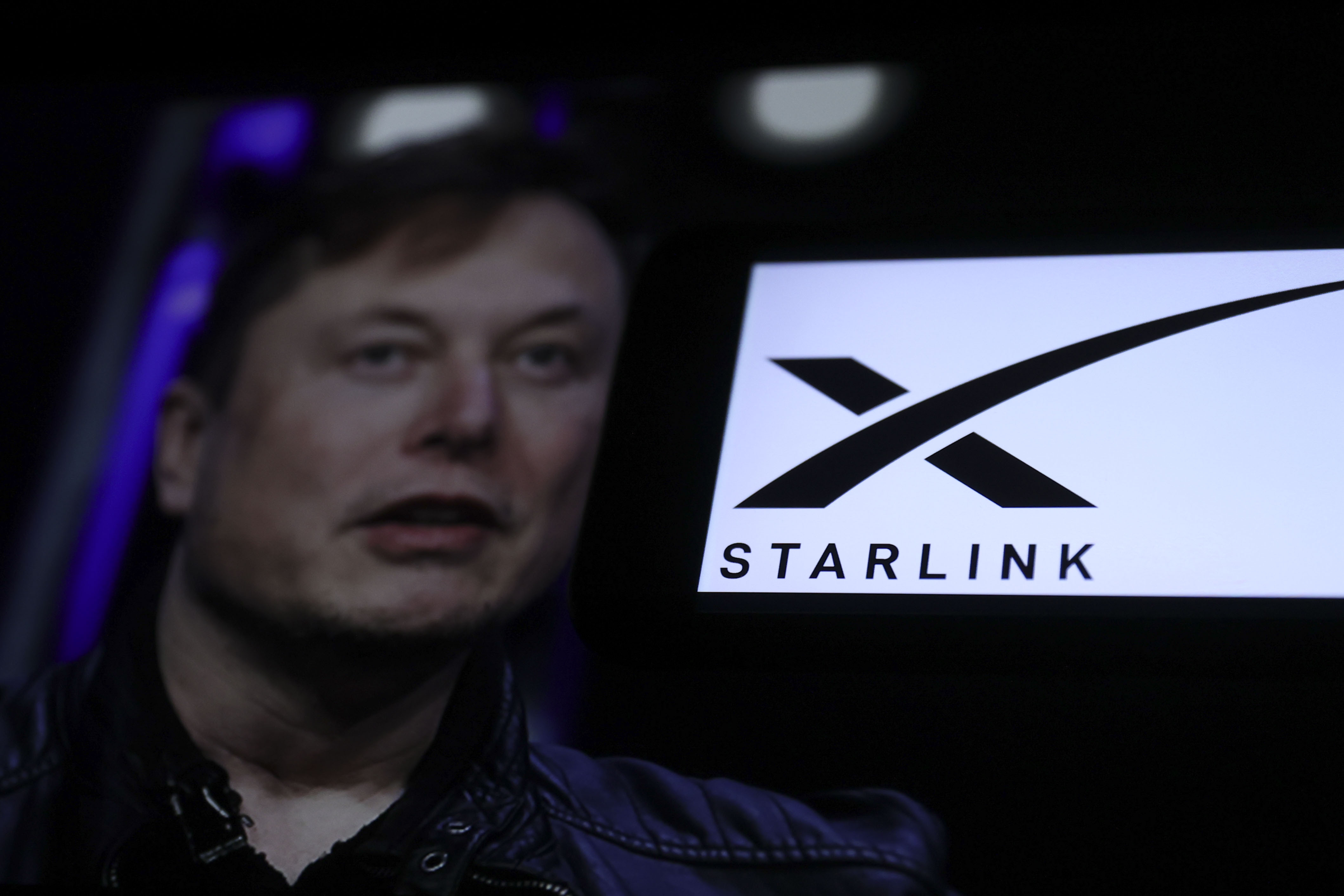
Small business owner Sozwani Joko felt he wasn’t getting the one vital resource he needed to run his community internet cafe: a strong internet connection.
His services – video conferencing, online faxing, internet training and email address management – were becoming harder to sustain. Not only was his internet connection weak, it was expensive and unreliable. So he decided to cross a border to fix it.
He had heard the Elon Musk-founded internet company, Starlink, was available in Mozambique, so he made the journey from his Inyoni Village outside the South African city of Nelspruit and crossed the border to its capital, Maputo.
“As a small business owner, I want to be a pacesetter,” Joko said. “I don't want to wait for ages before installing Starlink for myself, for my customers. I want to be in front of the queue because our internet companies here in South Africa keep failing us.”
Not only is Starlink not available in South Africa, it is also currently illegal. Joko has since been threatened, he said, by officials from the communications and digital technologies ministry.
“I was warned…that telecoms inspectors will visit all provincial businesses that provide Starlink services without registration. Something about fines and charges was mentioned in the call for anyone violating telecom laws,” he said. “I shivered instantly.”
The South Africa government’s hostility towards Starlink is sowing tensions that pits the state against ordinary citizens who believe Starlink is an affordable, reliable alternative to the few options they have currently – MTN, Vodacom, Cell C and state-owned Telkom. These, they say, are too expensive and unreliable due to record power blackouts and inadequacy of infrastructure in rural areas. According to Cable.co.uk report, a global broadband pricing measurement too, South Africa ranks 170th most affordable for broadband internet services, out of 220 countries.
No Starlink, or else…
Starlink must register as a company to have a legal presence in South Africa and cede 30% of equity to Black Economic Empowerment groups, the Independent Communications Authority of South Africa (ICASA), a state enforcement agency, demanded in April. These historically disadvantaged groups (HDGs) include Black people, women, young people and people with disabilities. Starlink has not done this.
“The Independent Communications Authority of South Africa (ICASA) confirms that to date, it has not received an application for any type of licence/certificate from Starlink or any satellite operators providing internet broadband services,” Pari Pillay, chief director in the South Africa ministry of Communications and Digital Technologies, told Open Democracy. Starlink has not responded to several requests for comment.
The ICASA bared its teeth in August, issuing a threatening letter to internet service providers who import and resell Starlink kits, warning they face losing broadband access, confiscation of equipment and possible criminal charges that could lead to hefty fines of ZAR 5 million (around £218,000). As a result, many have stopped using it. Though Starlink has not responded yet to the obstacle in South Africa, on its website it offers a hint: it states countries that have no registration or licensing requirements are assigned highest priority for its expansion. Those that have stringent registration rules like South Africa get lowest priority. Despite the threats from authorities, some in South Africa are still acting under the table, buying Starlink kits in friendly, nearby countries like Mozambique where the service is legal or shipping them there from the UK, and going across the border to collect them, before hooking them up in South Africa illegally.
Pricey, slow internet everywhere…
Some South Africans have criticised the “telecoms oligopoly” in the country, saying it only serves the government, which collects “lucrative tax” from these companies while keeping millions of citizens disconnected.
“The South African government’s motive is to block Starlink and protect legacy internet monopolies which charge high tariffs, which in turn they milk as tax cash cows,” Pride Gcaba, an IT technician in Johannesburg, told openDemocracy.
“Starlink is only expensive in initial kit cost but the world-class connection speed is well worth it for us small tech entrepreneurs.”
In neighbouring Zambia, a much poorer economy, 1GB of data is sold for around $1.30. In South Africa, the same fetches $2.60. The World Bank in 2022 ranked South Africa as the world’s most financially unequal country, and the injustice is evident in internet access: 7.5 million low-income South Africans are paying 80 times more than middle- and upper-income citizens to browse the internet, Project Isizwe, a non-profit, revealed in a 2021 study.
“Slow but pricey in South Africa is everything harmful for the poor: lack of access to vital tech skills, online education, diminished access to online healthcare tools and stifling of IT startups, digitised call centres that could create thousands of badly needed new era jobs,” said Pela Xolile, leader of the Tembisa Better Streets Initiative (TBIS) in an interview with openDemocracy. TBIS advocates for free internet in poor townships of Tembisa, one of the biggest low-income townships in South Africa.
In 2016, after militant #DataMustFall protests rocked the country, the big four broadband corporations slashed data prices. South Africa’s Western Cape government has rolled out various programmes to bring low-cost internet connectivity to all communities, especially very poor townships throughout the province. But it hasn’t worked, according to Arthur Gwagwa, a Southern Africa-focused tech rights lawyer, and former fellow at the Open Technology Fund.
“While internet and data costs have come down over the years, the major players (MTN, Vodacom, Telkom, Cell C) still dominate the market and make significant profits,” he said.
“This is why we want Starlink as soon as yesterday,'' Pride Gcaba, the IT technician said. He bought a kit from Mozambique and hopes to use Starlink’s much faster connection to launch an academy training low-income young people in professional online gaming skills.
Despite the clamour for Starlink, not everyone is sure it would be the great internet democratiser in South Africa.
“The attraction of Starlink in SA is not affordability. Poor people cannot afford Starlink packages. Starlink is for elites in its present packaging and pricing,” Gwagwa warned, arguing that Starlink could create more of the same – high-speed broadband for the well-off.
“Its attraction is better coverage in areas underserved by existing networks. The demand is from businesses and travellers for whom fast internet access anywhere is critical, particularly with the frequent electricity outages that cause network outages.”
But Joko says his internet cafe was seeing the benefits when he switched to Starlink.
"Electricity outages were not affecting me anymore because I could power my Starlink antenna with a battery,” he said. “The internet signals were high speed – I was fetching more customers than before – until authorities stopped me. Now my services have slid back – customers are disappointed.”


